GRANDMA AND HER FATHER
Accidents will occur in the best-regulated families. CHARLES DICKENS
I want to tell the story of my maternal grandmother, Evie Wilson Boteler. I don’t know how many installments it will take to share my memories of her; there are many, as she lived to be ninety-three. At my age, I can’t relate the stories or memories in perfect order; I can only tell them as they come to mind. She was the most important person in my life, because her home was very peaceful. We had our share of turmoil, as families do. But when I entered her house, any troubles I had were forgotten.
She was born Evie Caroline Wilson on February 12, 1892, in an area of Pinellas County called Bay View. It later became part of Clearwater. She was born on a lemon grove owned by a Mr. Sampson, in what they called a “hammock” between Bay View and Safety Harbor. Her father worked for Mr. Sampson, and the family resided in a cabin on the property. She was the first child born to James K. (“J.K.”) Wilson and his wife Velaria. Velaria was not quite eighteen and had been married since she was sixteen, not at all unusual in those days. I do wonder if Evie was actually born in the cabin; more likely she was born at the home of her grandparents, Dan and Sarah (“Sallie”) McMullen.
Grandma’s mother, whom we called Granny Wilson, was interviewed in her old age in 1950, and described life on the Sampson Grove as peaceful except for the year 1898, which was quite a year. It was the year of the “big freeze.” Anyone familiar with a sudden freeze to a citrus grove knows it can lead to immediate destruction of lives and incomes, especially well over a hundred years ago. Though only a child, my grandmother remembered the ensuing panic, and how smudge pots were frantically employed to save the crop. The grove was killed to the ground, but Mr. Sampson had lemon stock sent down from Orange Lake, which was grafted onto the trees. It enabled the continuation of the grove and saved several families’ incomes. (As I write this in January of 2022, I read that Florida is experiencing one of those freezes deadly to citrus groves, and the essential smudge pots are being hurriedly brought out.) Making that year even more calamitous, the family’s home was destroyed by fire. Granny also gave birth to twins, but one baby boy was stillborn.
This leads me to a story I heard about little Evie and the house fire. She was six years old when it happened in that eventful year of 1898. J.K. got his wife and children out of the cabin, taking a bad fall in the process. He tripped over something left in front of the door and for the rest of his life was adamant about anyone leaving anything near a door. Fire was an enormous threat in those days; sadly, a house fire was not uncommon. I remember Grandma telling me about the fire as a warning to never leave anything in front of a door. But my cousin Margaret told me an astonishing detail that was left out of the story.
Grandma’s parents counted heads after they escaped, and came up with one missing – hers! Little Evie had run back into the house to save her new Sunday dress. Despite being only six, this reckless behavior seemed out of character for the grandmother I knew. Even her childhood photo shows a serious-looking little girl, and she was in awe of her father. It seemed incredible, but coming from Margaret, who “knew things”, I believe it was true. I can see why Grandma neglected to tell me “the rest of the story.”
Most of her childhood stories involved her father. She and her siblings had great respect for him. One story she told was quite bittersweet. It was about when she went with him to Tampa to pay his taxes. Clearwater was still part of Hillsborough County at that time. Pinellas County did not secede from Hillsborough until 1912. The causeway to Tampa had not yet been built, so the only route was around Tampa Bay through Oldsmar. It was a trip of about thirty miles by horse and wagon, and Granddaddy Wilson would spend the night at a boarding house.
He usually went alone, but Evie wanted so badly to go that he took her with him. I am guessing that she was about ten years old, so this was around 1902. I could tell as she told the story that she was proud to be allowed to accompany her father. On their way back the next day, the lady at the boarding house sent a custard pie with them. Evie was allowed to eat a slice as they rode. Unfortunately, it had spoiled. It made her very sick, and the little girl had to lie in the back of the hot wagon all the way home. Her disappointment in the ruined trip, even in old age, was somehow very moving.
When they thought no one was listening, I used to hear Grandma and her sisters tittering about the “Cousin Helen” episode. It was a pretty wild story for back in the day. Helen, their father’s niece, was very carefully brought up. Her family lived in South Carolina. As young teens, the girls and their parents made the long trip from Florida for a visit. The town was more “citified” than Clearwater in the early 1900s. The Clearwater girls felt slightly patronized by Helen, who seemed to regard them as “country cousins.” No doubt meaning it kindly, she took them to the “moving pictures.” She called it a special treat for them, saying that “she could go anytime she wanted.” That particular phrase seemed to rankle the girls. Growing up, I heard them say it many times, obviously as a private joke between them.
J.K. wanted the best for his children, especially an education. Maybe Helen, refined and demure, was someone they should emulate. But when Helen was a young woman, probably around 1920, things took a mysterious and scandalous turn: She ran away from home.
Helen eloped with a man she always referred to as “Mr. Smith.” She was gone for years, with her whereabouts apparently unknown to the family. My cynical mother used to wonder if Helen had ever married “Mr. Smith.” Was he perhaps already married? Granddaddy Wilson didn’t mention her anymore, and I can imagine Grandma and her sisters being shocked and yet giggling about it. I say this because I was drawn into the saga of Helen the summer I was going on twelve years old.
In the 1920s, to escape the summer heat, Granddaddy Wilson bought an old country house in the mountains of Brevard, North Carolina. It was built before the Civil War. He died in 1933, but the sisters and their mother continued to spend the summers there. It became a pleasant family tradition throughout the decades, Grandma and Aunt Lula becoming the last of their generation in the 1980s.
That fateful summer of 1960, my mother and I were in Brevard for a couple of weeks. Suddenly, a big event unfolded. My grandmother and her two remaining sisters, Aunt Lula and Aunt Emma, were going to visit Cousin Helen! My mother was enlisted to drive. We were invited for lunch, and we set off the next morning. The town was over sixty miles away with I-85 not yet completed, and I remember it being a winding trip taking a couple of hours. I sat in the front seat with Mom, and the three sisters sat in the back. As people do when kids are around, they kind of forgot I was there. Apparently this was their first time seeing Helen since she finally returned home after who knows how many years.
The ladies were by that time in their late sixties. I was bored by the whole idea and didn’t want to go, but you did as you were told in those days. Suddenly the conversation from the back seat started to get interesting, and my ears perked up. That’s when I first heard about Helen’s “elopement.” Soon my mother also had one ear tuned to the “gossip” in the back.
I don’t know what the town is like today, but back then it was charming, full of lovely old homes. We pulled up in front of a white frame house with a picket fence and a garden full of beautiful dahlias. But when Helen came to the door, I did a double-take. She was tall, and a little scary.
My grandmother and my great-aunts looked their age. They got permanents at the beauty parlor for their naturally greying hair, and wore a little powder and Tangee lipstick. Helen, unlike any elderly lady I knew, had bright blonde hair, along with red lipstick and a lot of rouge. She had on big white “callow-tab” earrings, and a good bit of other jewelry. The rest of her outfit consisted of casual “pedal pushers”. Grandma and her sisters never wore pants back then. They had on nice old-lady dresses, and of course their pearls. But the wildest thing about Helen was that she was smoking!
Her voice was loud but friendly, and she seemed glad to see her cousins. The sisters’ good manners overcame their shock and hugs were given all around. I didn’t dare look at my mother, knowing that I would break into nervous laughter. So this was “demure” Cousin Helen.
The lunch was hospitable, but not up to my grandmother’s standards. She would have fried a chicken and fixed potato salad, etc. for such a special occasion. Helen only gave us tuna fish sandwiches, though she did serve them on fancy china. She rather dominated the conversation, and spoke frequently of “Mr. Smith” and his business acumen, though other details about him were vague. Apparently he was long gone by now. Outwardly, the sisters appeared to accept their visit to this alternate universe as the most natural thing in the world.
Helen seemed to have lived an eventful life, and her voice level kept increasing. My mother later wondered aloud if Helen had a drink before we came. I very much doubt it, but Mom enjoyed shocking her mother a little bit. Politeness forbade referring to her disappearance, but somehow I got the impression that Helen had been in California all this time. Anyway, after two or three hours we left in kind of a daze, Helen waving goodbye with cigarette in hand. The old ladies were quiet in the back. They now seemed aware of my presence and spoke only in whispers.
Mom and I shared a bedroom in Brevard, and that night we stifled laughter about the whole awkward experience. But faintly through the door I could hear giggles coming from downstairs too, from the country cousins.
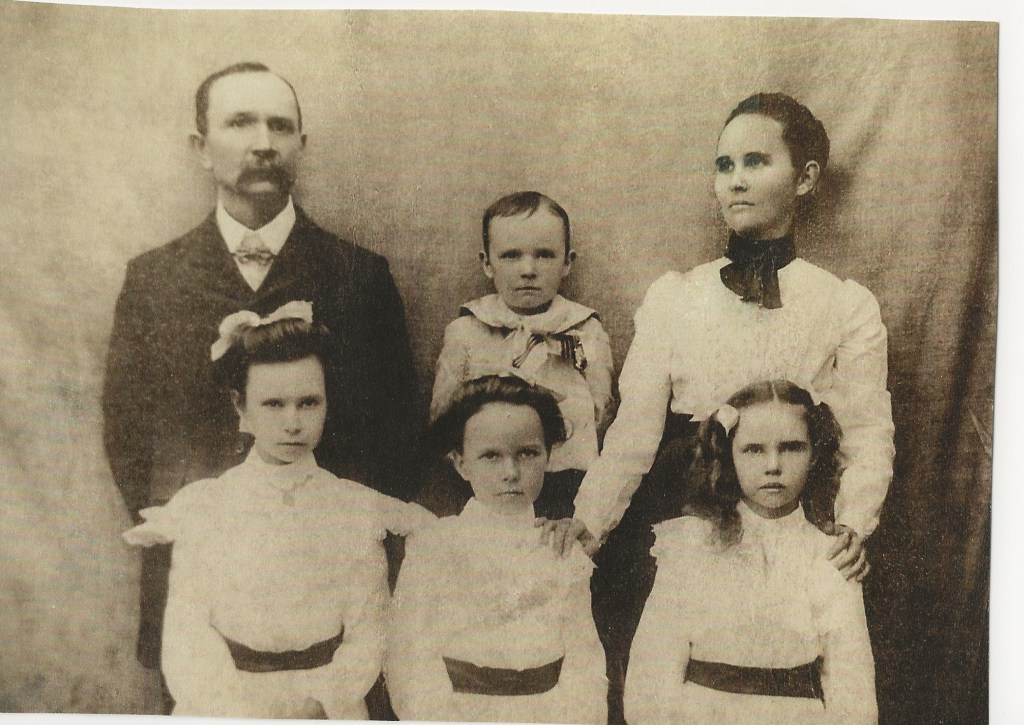
Grandma on front row, far left with Emma and Lula. Their brother Kelly is in the back with their parents. The youngest child, Elizabeth, was not born yet.
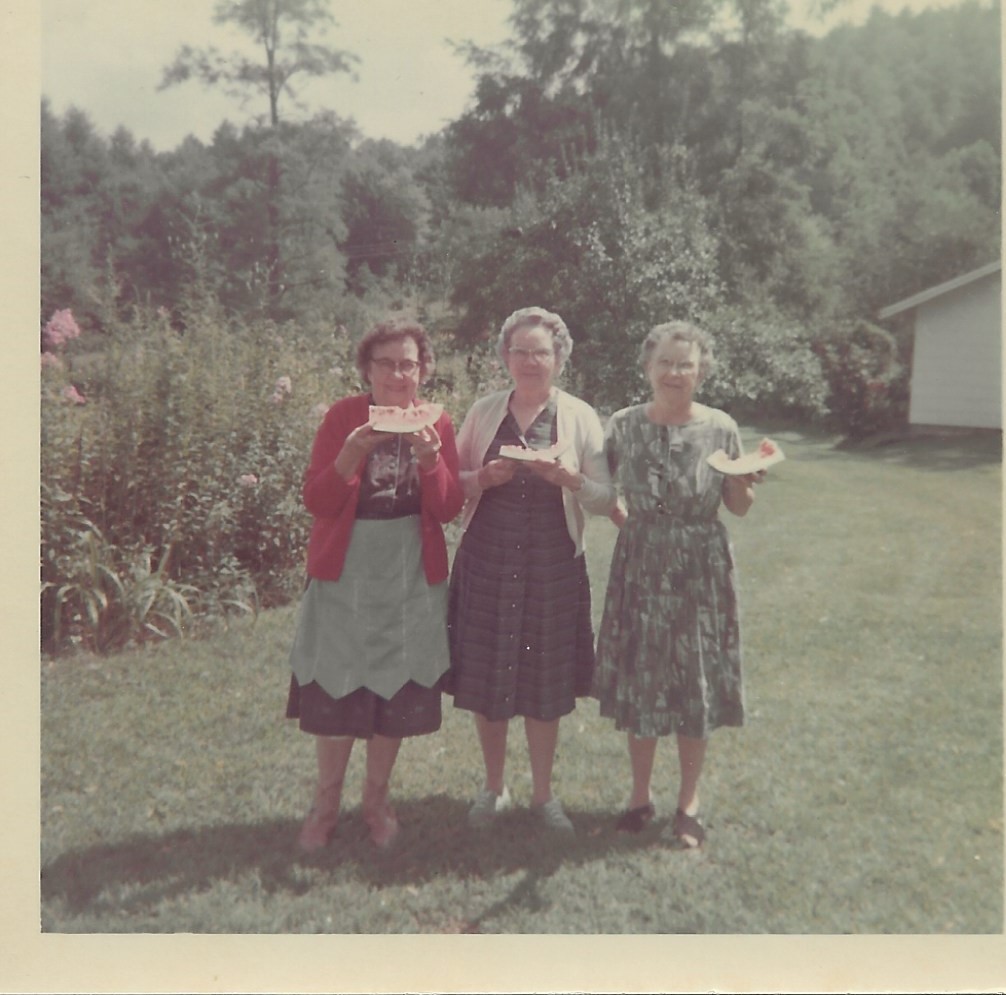
Aunt Emma, Aunt Lula, and Grandma. This was taken in Brevard in the 1960s.
 Old Florida Girl
Thank you so much, Chrissie! I’m trying so hard to remember details for you young folk! Love you too!❤️
LikeLike
Hi Jeffrey, I love these stories about our family. Thank you so, so much for sharing them. They always bring back happy memories of Grandmother. Love you always, Chris
LikeLike