GRANNY
The foregoing generations beheld God and
nature face to face; we, through their eyes.
RALPH WALDO EMERSON [Nature] 1836
My great-grandmother knew me, yet she didn’t know me. She could sometimes speak my name and talk to me, but her voice was very soft and a little bit garbled. She was always in a chair and couldn’t walk by herself. My mother said she had “hardening of the arteries.” I never knew my great-grandfather, since he had been gone since 1933. Granny died in 1958 at the age of eighty-four. I was only ten years old, so my memories of her are dim. But my impressions are of a gentle old lady much loved by her family. It was then and it is now hard to imagine her in the 1800’s as a young girl growing up in sparsely populated Florida, riding to school on horseback. Her children and grandchildren said that she loved to laugh.
I always felt that her story was typical of most Americans at that time, balancing a need for survival and love of family. She was born Velaria Elizabeth McMullen in 1874, the oldest of twelve surviving children, born in her grandfather’s log cabin. He was James McMullen, though he went by Captain Jim. They lived in an area then known as Bay View, near the Tampa Bay side of what became Clearwater. Later her father Dan homesteaded nearby and built a house close to the McMullen Cemetery. There are many good genealogists in my family that can relate detailed stories about those times. I can only add my fading memories of what I have been told.
Granny was interviewed for the Clearwater Sun in 1950, and gave many interesting details about life back in the nineteenth and early twentieth centuries. It was a look at a bygone world involving unbelievably hard work, and devotion to family was paramount. They were from a clan originating in Scotland who eventually found their way to Florida in 1850. They were hard-working farmers, pioneering the state, and their main crop was citrus. Granny remembered though, that hospitality was an essential part of life. She loved it when there was some sort of celebration and everyone gathered at her grandfather’s cabin. In the days when everybody had umpteen children, these gatherings must have been something to behold. Music and food spread out from the house to under the trees. They played games and danced. The music was comprised of fiddles and even an organ.
Her life as the oldest daughter of twelve children did NOT involve opting out of chores. Very hard work was involved just to survive in those days, and everybody had to help. She had to be her mother’s right hand and learn how to cook (including for the hired man), run a house with all that that entailed, tend to animals, and help out on her father’s grove when necessary. She said that her schooling was interrupted a lot because she had to help her mother so much. It all sounds harsh today, but the old ones in my family spoke mainly of square dances, music, and lots of laughter when the work was done. They talked about giving love and care to the little ones, of whom there were many. I was told by my cousin Jean that the big family loved children; they were enjoyed, and the little ones indulged.
In 1890, when she was sixteen, she married James Kelly Wilson. They met at church. He was older that she was and a bit established. You had to be in those days before you took on the responsibility of a family. Velaria was married at the foot of her mother’s bed because her mother was still recovering from childbirth. She said that this was her only regret – leaving her mother with a new baby. She must have had her parents’ blessing, but the mindset of an oldest daughter was hard to shake off. One story I love shows the wisdom of her new husband. He didn’t like to dance, but being sixteen, she did. What he would do was take her to square dances and let her dance to her heart’s content while he sat on the side. She was young and I love how he understood her need for a little fun.
Granddaddy Wilson came from South Carolina, and worked for the owner of a lemon grove, Mr. Sampson. His dream was to own his own grove. He and Granny worked extremely hard to make this happen, while raising five children. The oldest was my grandmother, born in 1892, and she remembered how hard her parents worked. The children had to help the best they could. What they could do was size fruit. I guess the oranges passed down some sort of chute, and the children’s job was separating the smaller oranges from the more desired large ones. My grandmother also told how she went to Sylvan Abbey School on horseback just as her mother had done. I loved to picture this, because I had never seen my grandmother on a horse in my life. I guess children just assume that their elderly relatives were born old.
Nobody gets through life without enduring grief, and Granny had her share. In 1898, after having three girls, she had a boy, James Kelly Wilson III, whom they called Kelly. He was born a twin, but his brother died at birth. He was a much longed-for son, and loved by his sisters. A few years later another daughter was born, and that completed their family.
In 1921, when he was twenty-two, Kelly was riding with two other boys in a cut-down unpainted Ford. I have been told that it was one of the first cars in Clearwater. They were driving along the beach and attempted to climb the car back up on the road. It wasn’t even a hill, but of course the sand was very soft. The right front wheel crumbled, causing the car to turn over. One boy was thrown clear, but Uncle Kelly and the driver were pinned under the car. The driver escaped serious injury, but Uncle Kelly was killed. It was ruled an accident with no one to blame, the car going about fifteen miles an hour. I wonder since cars were so new if the boys just didn’t understand about soft sand.
My friends who have undergone the tragedy of losing a child are the only ones who can understand how Granny and Granddaddy felt. Naturally, things were never quite the same. Granddaddy rallied a little better than Granny, but she grieved a very long time. It was talked about so often in our family. My grandmother would talk about the death of her brother when I was a child in the 1950s. I didn’t even realize that it had been over thirty years. It affected all of them. Even my mother talked about Uncle Kelly, who died before she was born. But somehow life went on.
Before this time, the family had moved closer into town and had a grove near South Ward School, to provide the children a better opportunity for education. Clearwater was still pretty rural. After the girls were mostly grown and married, Granny and Granddaddy felt that the city was growing too fast. They moved to a house on Druid Road. It had a little acreage and was still in the country. This is the house that I remember. It wasn’t what you would call rural in the 1950s, however. What would they think today!
Despite the sadness that every family endures, my memories of our gatherings at Granny’s are of laughter, stories, and plenty of food. We kids played outside and would get stains from the big mulberry tree growing there. The barn now housed a car. Being an only child, to me all the family under one roof seemed enormous. But being one of twelve, I bet Granny didn’t think so.
This is dedicated to Dora Ward, a dear friend of Old Clearwater and a wonderful storyteller. She was much appreciated and is greatly missed.
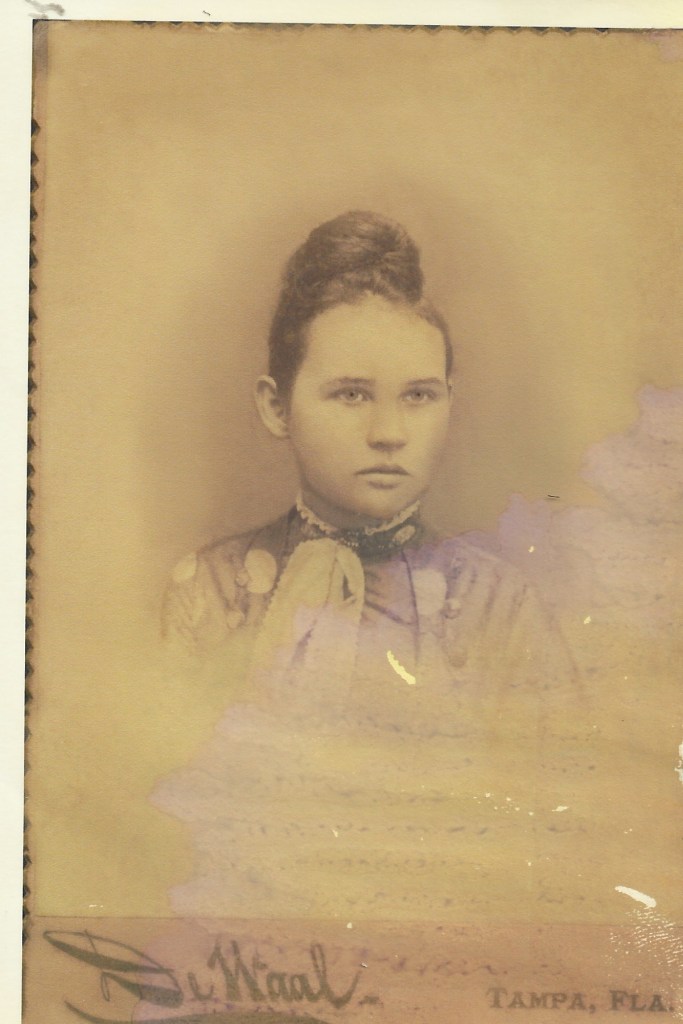
I think this is Granny’s wedding picture, probably 1890.
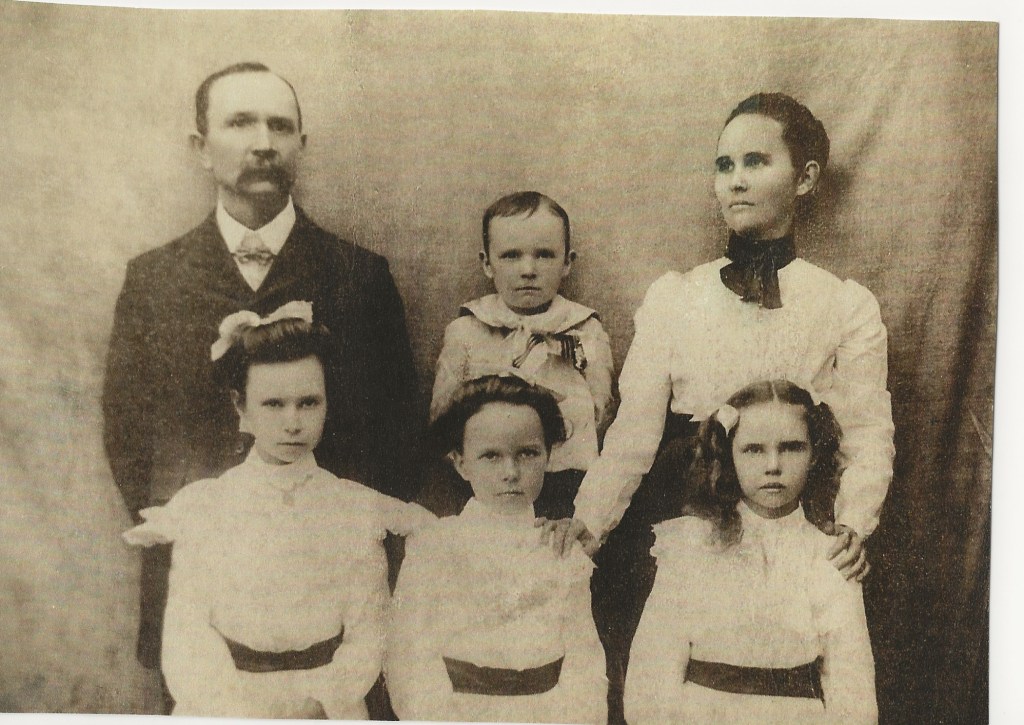
The Wilson family about 1902, before their youngest daughter was born.
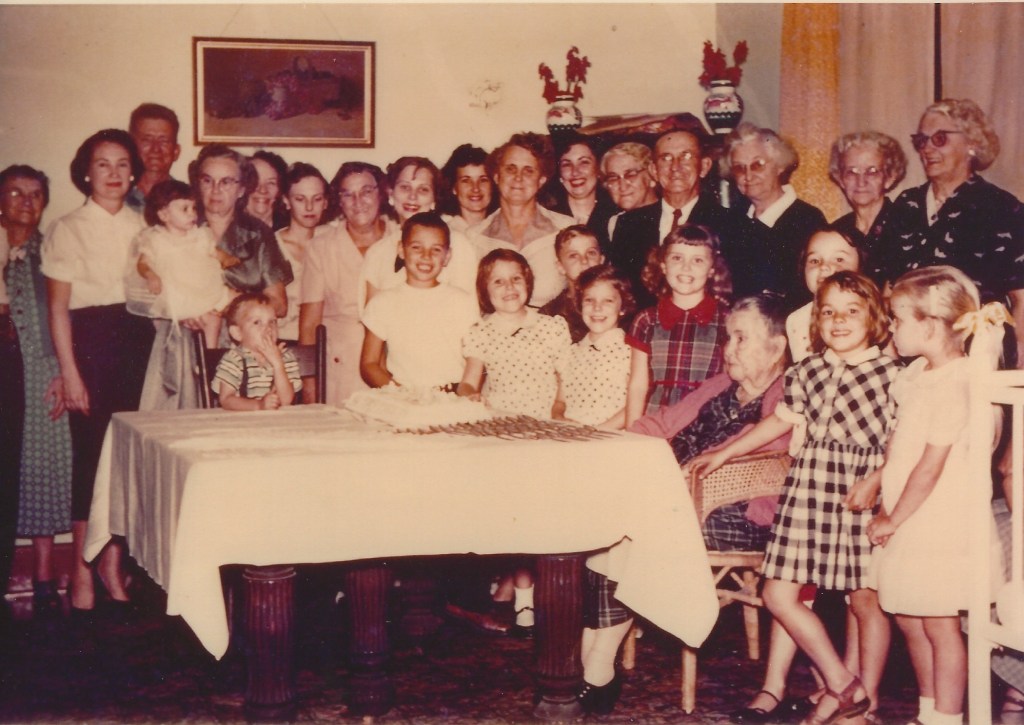
This was taken in 1958, a month before Granny died. This is just part of the family.


I enjoyed reading your story of Aunt Velaria. My father and his sisters talked about her often. I recently visited with the granddaughter of Aunt Velaria’s youngest sibling (Joe McMullen, born 1900). When I told her about your story, she said that she had always heard about Aunt Velaria, too. I think those siblings must have enjoyed each other.
LikeLike
Thank you so much, Marilyn. Family was so important to her. I wish I had a clearer memory of her siblings that I met I childhood. They were so important to her, as I always heard. Hope to see you again if I can ever get to another McMullen reunion.
LikeLike
Wow, my grandmother grew up in a large family too on a farm in Ga. She was also the oldest! They all had a lot of responsibilities back then. Her mother died when she was 12, so she was expected to care for the younger ones. I love reading how Clearwater was back in the day. Unimaginable!! Your stories are SO interesting!! Keep it up!
LikeLike
Thank you so much! I did figure a lot of people could relate to stories their grandparents and great-grandparents told.😊
LikeLike
Oh my, how hard on your grandmother to lose her mother; she had to grow up in a hurry. Also, I think Florida was more like Georgia and other southern states in her day. People didn’t go to the beach, etc. There was no bridge to Clearwater Beach or even to Tampa. You had to go in a boat.
LikeLike
Or the long way around through Oldsmar.
LikeLike
This is so fascinating! Beautifully written, and I love the pictures!
LikeLike
😊❤️
LikeLike