BEACH KID MEMORIES

Carefree to be, as a bird that sings;

To go my own sweet way . . .

                          ROBERT WILLIAM SERVICE

     Commenting on my childhood, my mountain-boy husband often says, “You had the greatest life as a kid.  You lived on the beach, you went there any time you wanted, you could walk to it,” etc.  And then I will answer, “But we didn’t have air conditioning, it was terrifically hot, and we constantly sweated like sinners in church!”  But finally I have to say, “I was just trying to make you feel better, because I did have a great childhood on the beach.” 

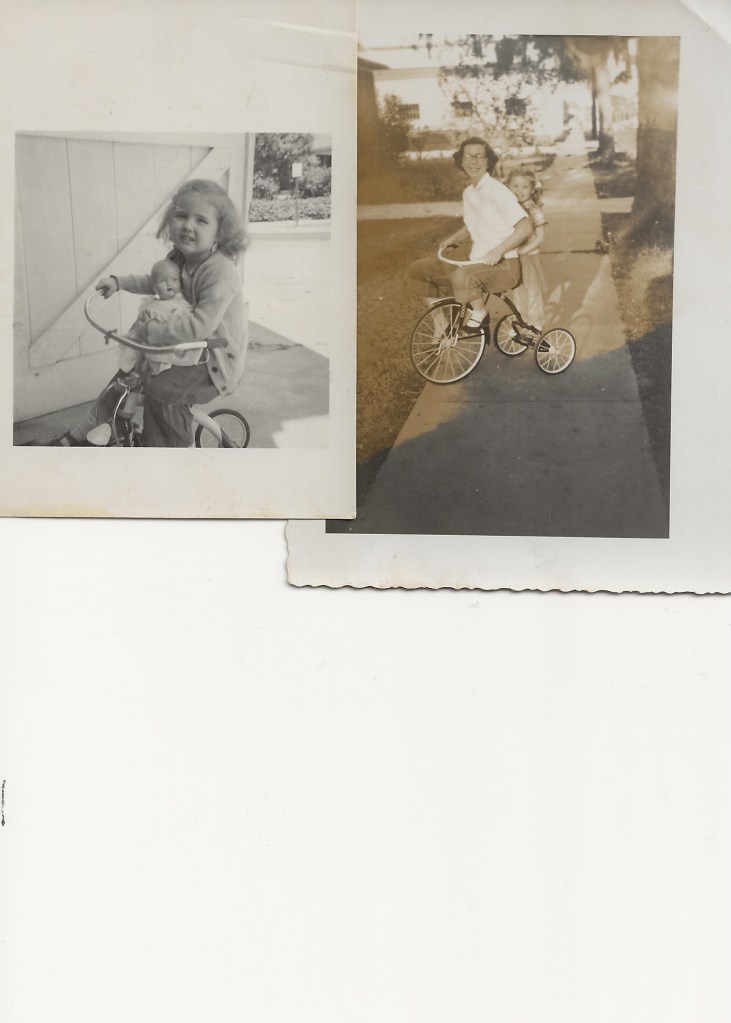
     We lived on Clearwater Beach from the time I was eight years old until I was twelve, from 1956 to 1960.  My mother and I had returned from Alabama after she and my dad split up a couple of years before.  After staying with my grandparents in town, we eventually moved to a garage apartment about half a block from the beach.  It was located at the home of a very warm and kind family from Cuba.  They had a shaded grassy garden that separated their large house from our apartment over the garage.  I seem to remember a little fountain there too.  They let me play in the garden all I wanted. 

     Being a redhead, Mom wasn’t a “sun worshiper,” but she would often walk me over to the beach on the weekends.  Sometimes we would go for lunch at the Palm Pavilion, her old high school hangout from the 1940s. I had learned to swim when I was about five or six years old in Alabama.  In Clearwater, when I was about eight, the Red Cross would pick us up from school and take us over to the beach for swimming lessons.

     Later, when I was nine years old, my mother married a very nice man.  I consider him my father today.  We moved into his house at 628 Mandalay Avenue, on the beach side.  Mandalay still divides the beach and the bay.  It was the main drag, although it didn’t seem real busy up our way.  It was scattered with a few Mom and Pop motels and businesses, and had a family feel.  

     Every block or two, there were little side roads made of ground shells and sand – our access to the beach.  I often went there by myself to play if I couldn’t find a friend to go with.  I’m embarrassed to say that I wasn’t really good at telling time yet, although I had been given a watch.  I  would just swim, play in the sand, etc., and somehow I knew when it was time to go home.  Despite the “don’t talk to strangers” rule, I was given permission to ask some nice lady with her family what time it was.  This was supposed to be a rare exception.  I can’t remember when the beach wasn’t full of people except in winter time.  Yet it never seemed crowded.

     I don’t ever remember my mother coming and finding me, so I must have been pretty good about getting home when I was supposed to.   It was boring to stay there all day if I wasn’t with a friend, anyway.   I do remember having certain boundaries, and I couldn’t stray too far from our area.  There were Australian pine trees on one side and a house that was my boundary on the other.  I would set my towel in the shade of those pines among the fallen burrs for my “reserved spot.”

     Mom probably told me that I couldn’t go out in the water past my waist.  I would “body surf” if we were fortunate enough to have some waves after a storm.  A lot of us did that.  Otherwise, everyone knows that the Gulf of Mexico is usually very calm.

     I remember something exciting and unusual – a shark fin had been spotted in the Gulf.  The lifeguard blew his whistle for everybody to get out.  There was a lady floating on a plastic raft in only ankle-deep water.  I remember her screaming and yelling for her husband to come drag her in.  Everybody was staring at her, and I remember thinking it would be faster if she just jumped off the raft and ran in!  I don’t know if we were ever allowed to go back in the water that day, as we couldn’t go back in until we heard the lifeguard’s whistle.   I seem blasé about it, but the occasion was so rare that people were more surprised than scared.  The scarier part to me was always jellyfish season.  They were nasty looking and could give you a bad poison “burn.”  I would move at lightning speed if one of them brushed my leg; we would all get out of the water if we saw them in swarms. 

     To add insult to injury as far as my husband is concerned, I had access to a swimming pool courtesy of my good friend Diana.  Her parents managed the Surf Sun Motel across the street.   In later years, it was purchased and renamed the Royal Canadian, and is still there today.  We were allowed to play in the pool as long as we didn’t bother the guests.   I remember us running up and down the outside stairs; if we were lucky there was a vacant room and we would play in there.  (I have a feeling this happened only in the off-season, when there were very few guests.)  So having the beach in the “back yard” and a pool in the “front yard” is another reason for my husband’s “envy.”

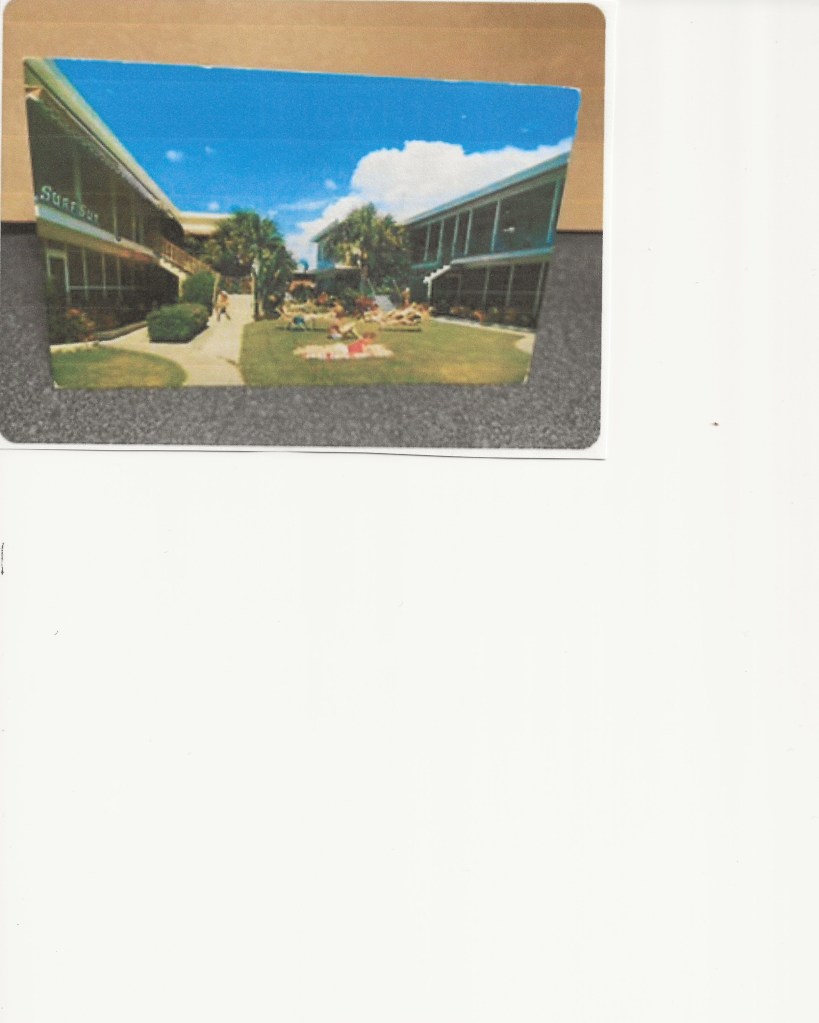
Diana’s “Surf Sun” motel.
Back view of the Surf Sun.

     At school, we were the “beach kids” when it came time to line up for the buses, although our grammar-conscious teachers called us beach “students.”  This was at North Ward Elementary in town, where all “beach students” were zoned.   Every morning our school bus made the drive along the causeway, crossing the bridge onto the mainland.  As we drove along the causeway one morning, I remember thinking to myself that I lived in a beautiful place.  But it was a fleeting thought, as we were fascinated and excited watching the daily dredging in the bay that was to become the foundation for Island Estates.  It was a big, new “daring” development , and its progress was on the news nightly.  It seemed scary to me, as I heard adults saying that it was never going to work, it would be unstable, etc.  There was a boy in my fifth grade class that lived in one of the first houses built there, which seemed rather “exotic.”  Now, well over sixty years later, Island Estates is still there. 

     Diana remembers what we called the “The Spear Club” that our friend Sonny Bobo started.  He was a friendly and cheerful boy, sadly gone now.  There wasn’t much to our “club” activity.  We would take palm fronds and somehow turn them into “spears.”  I don’t remember doing much with them except I guess standing around having “duels.”    

     We were often at the Youth Center over on the bay side, very shady and piney.  All sorts of fun lessons were available.  You could learn to sail a pram there.  For those unfamiliar with the term, a pram is a small personal sailboat.  I sure did envy the kids who had them.  They said it was so much fun to take your pram out on the bay, and of course it would be!  They had races too.  I never even asked my parents about this.  Although my father owned an old “trawler” which he used for fishing once in a while, I was sure that my thrifty parents were not going to invest the time and money.  But I’m still sorry that I didn’t ask!
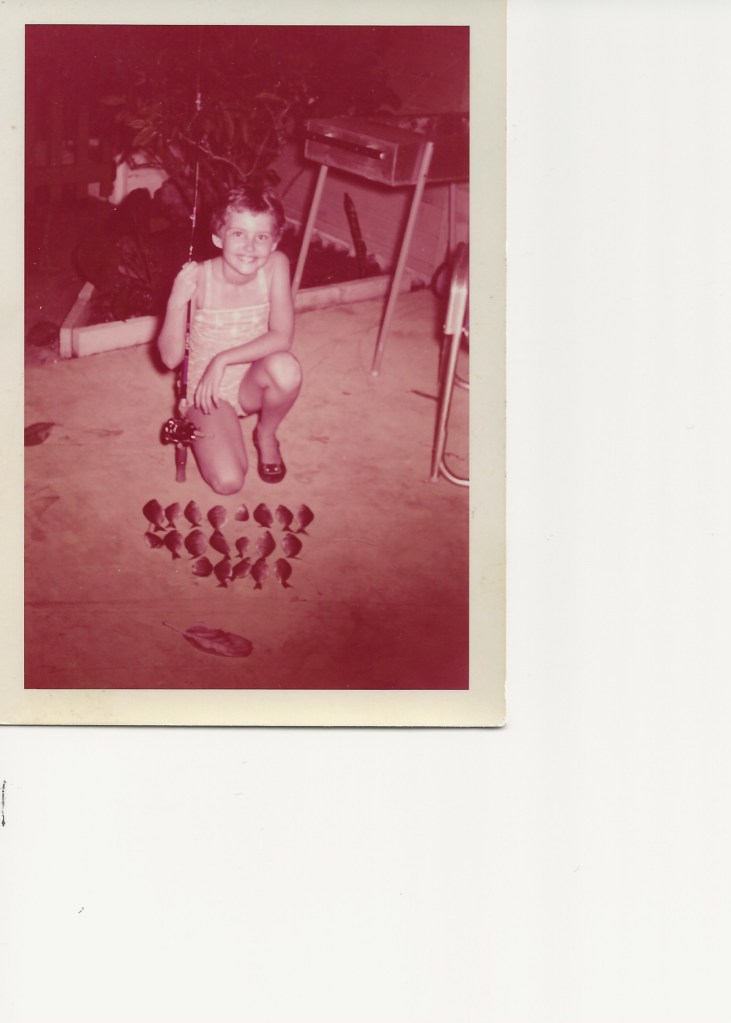
Me at ten years old with my “catch” from my father’s boat.

     Diana and I also walked ourselves to church.  It was called Chapel By The Sea, just a few blocks down.  It was interdenominational, and is still the only church on the beach.  My parents weren’t church goers – a little unusual during the 1950s.  Diana and I were in junior choir, though I think I was only in it for maybe a year.  I loved to sing, but I confess that the main reason I wanted to be in the choir was so I could wear a robe.  My parents would pick me up after church once in a while if it was raining.  I also remember my father taking me to church if it was bad weather.  He was a good and kind man, and never refused to take me.  He just didn’t want to go himself, for whatever reason.  He was born in 1915 and raised a Quaker.  But that’s a story for another day.

     We belonged to a Girl Scout troop, up towards the north end of the beach at our friend Sandra’s  house.  Her mother was our leader, and was a very sweet lady.  We had fun, and I remember that we went camping one time at Phillipe Park in Safety Harbor.  My parents were chaperones and actually camped overnight with us.  My father loved to camp and my mother was a good sport.  We girls had fun running all over the place in the dark. 

     My mother probably drove me to Girl Scout meetings, as they were after school.  I did ride my bike to my piano lessons, further north in the Carlouel neighborhood.  That was the way it was; we rode our bikes almost everywhere.  The only restriction I remember was my mother not letting me ride my bike in the heat of the day if it was unusually hot. 

     There were some sad occurrences during the “good old days.”  In the fifth grade, our friend Mary (and fellow Girl Scout) became very sick with rheumatic fever  She was confined to bed for five months.  Our class got her a plant, and my mother brought it home.  Like all girls, I had a basket on my bike, and I rode up to Mary’s house on Acacia to deliver it.  I remember her mother serving me some delicious Greek cookies in their kitchen, the first time I had ever tasted them.  I became a lifelong fan!  Mary has since told me that rheumatic fever is now basically wiped out, thankfully along with several other diseases.
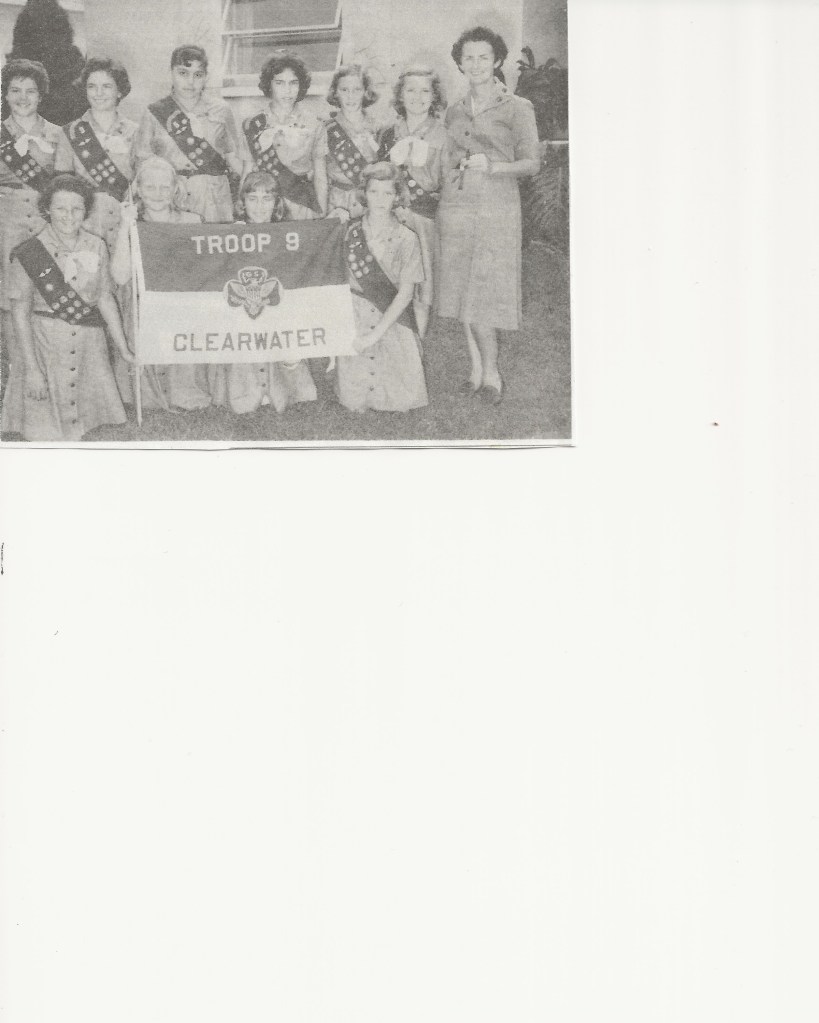
Our Girl Scout troop. Back row: Mary is third from left and I am next to our leader. Diana is on the front row, centered behind the flag.

     There was also a “haunted house” up that way, although someone just happened to live there.  It was a big, beautiful Mediterranean style house – I don’t know why we thought it was haunted.  Maybe because it was large and no one was ever seen there.  Diana and another friend were brave and actually went up and knocked on the door, pretending to sell Girl Scout cookies.  (They just made that up.)  Diana was a lot more daring than I was.  She said a lady answered the door and saw right through their “scheme.” 

      Many Saturdays I rode my bike to the Pier Pavilion, a nice big public pool right on the beach.  I would stay all day, usually including time at the miniature golf course located right in front of it.  I would work up my courage to jump off the big high diving board at the pool.  Having a line of people waiting behind me was good motivation.  The one time I dared to dive from that height caused quite a wallop to my head when I hit the water, and parted my hair perfectly down the middle!  I was probably about ten or eleven then.  My mom always gave me money for a hot dog and to play miniature golf.  Then I would ride my bike home, happily tired but usually sunburned.

     As I look over what I’ve written, it reads like a case for Child Protective Services(!)  Despite what it looks like, our parents were far from lenient.  All I can say is that’s “the way it was.”  I guess the majority of our mothers were at home, but they didn’t have time to drop everything and take us places.  It took all morning for my mother to remove the wax from the kitchen floor and re-wax it, for example.  She did have a washing machine, but no dryer. When we moved to the mainland into our new house, the big excitement was having a dishwasher.  But my mother still didn’t have a clothes dryer for the next year or so.  She hung everything out, as most of our neighbors did.  And still no air conditioner!  Finally, with our house next to an orange grove and away from the Gulf breezes, my parents broke down and put an air conditioner in the living room and their bedroom, which reached down the hall and cooled my room somewhat.  But it was better than nothing!  None of my schools were air conditioned, except for the auditorium at the high school. 

     My older grandchildren regard those days (politely) as prehistoric.  They almost can’t believe me when I tell my stories, and they too envy my childhood that had more “freedoms.”  I try to tell them about the bad things also, but somehow I can’t help dwelling on the “good” in the “good old days.”   
THE EDUCATION OF GRANDMA

Education is the best provision for old age.

ARISTOTLE [384-322 B.C.]

        I’ve mentioned before that my great-grandfather valued education.  I suspect it was because he didn’t have a whole lot of it himself.  He was born in 1861, when all young men had to work very hard to survive.  I guess that’s why he wanted it so badly for his children.  Your body could wear out, but education would be protection against poverty.

     His oldest daughter, my grandmother, was like him in that respect.  She and my grandfather sacrificed a lot so that their daughters could be educated beyond high school, and this was in the 1930s during the Great Depression.   I don’t know how they did it. The girls did have jobs, and maybe some small scholarships.  Somehow, though, I got the impression that my grandfather wasn’t “all in” on the idea.

     Grandma was a member of the first graduating class of Clearwater High School, in 1910.  At that time, a lot of people considered twelve years of schooling unnecessary.  Granddaddy went through the eighth grade, which was considered a complete education.   Girls certainly had a lot to do at home until they were married, and young men found employment with their hands – good employment if you were skilled.  My grandfather learned to be a carpenter.

     I don’t think Grandma had any great scholastic ambitions; she just enjoyed figures and bookkeeping, and was good at it.  She loved cooking and flower gardening; to her, those were the creative areas of running a household.  She wasn’t one who aimed to “do it all”; she just lived her life and tried to find pleasure in mundane things.  And she put her bookkeeping skills to use in later years when she and Granddaddy rented out rooms to “winter guests.” 

     In her teens, she had a best friend named Fanny, and they were friends all of their lives.  Grandma used to talk about how much she missed Fanny when she moved with her family to Atlanta.  When I was junior high age, I would ask Grandma what they did for fun; did they go out with boys?  No, that sure didn’t happen, but apparently they did have supervised gatherings with boys.  She described how a group would pull taffy at home, which sounded like fun.  She said they would also make mayonnaise together(?).  I’m ashamed to say that I was rude and laughed out loud at this – how boring!  I still don’t understand why that would be a fun group activity; I guess I don’t know enough about the times. 

     After high school, she went to Southern College for one year.  It was located in Palm Harbor, which was called Sutherland at the time.  She boarded with relatives, and I feel sure that she must have studied bookkeeping and business.  She finished in 1911 or 1912.

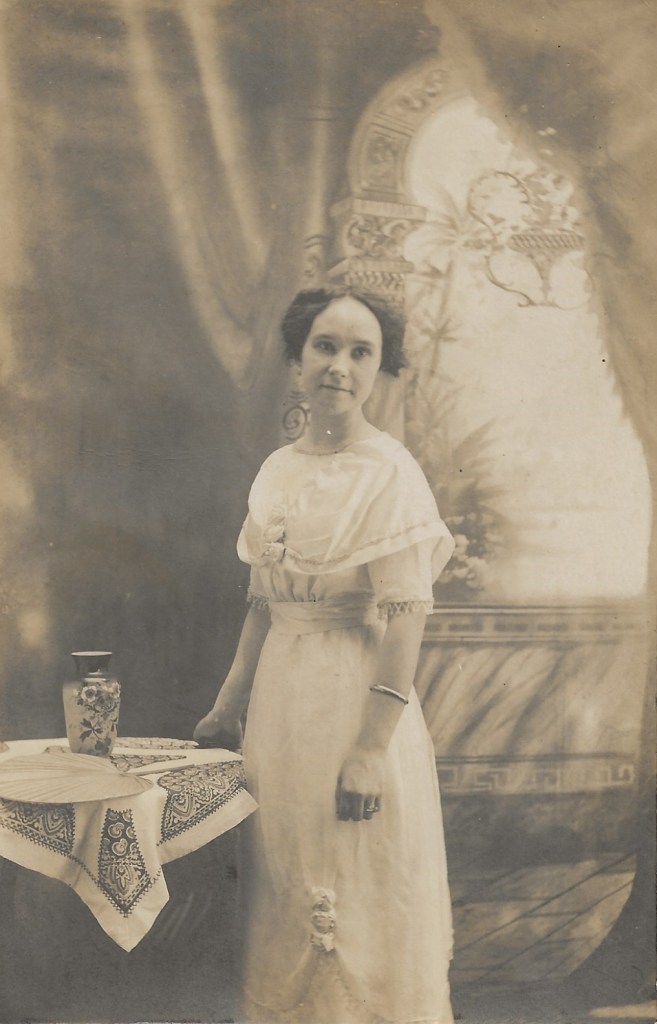
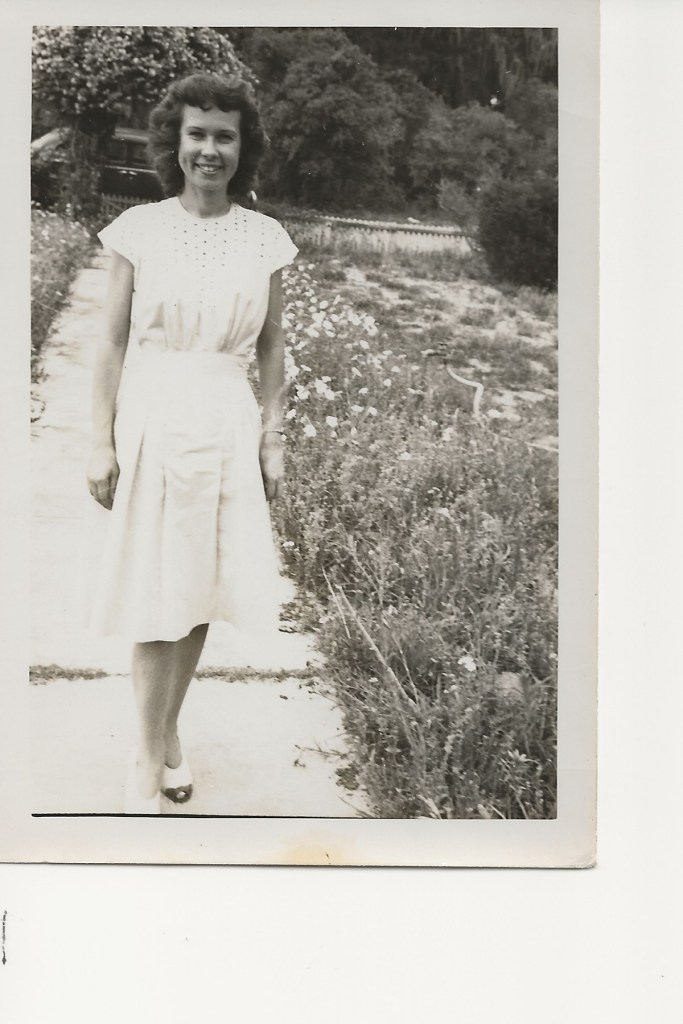
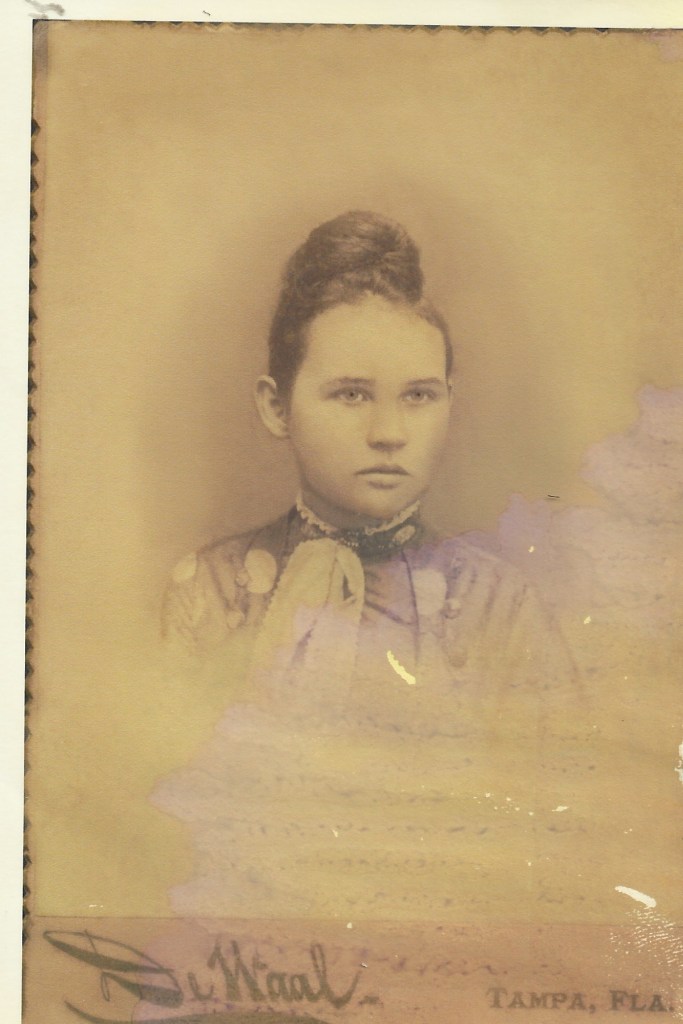
     I have a picture of her that I love.  I think it was taken when she graduated from high school.  She seems so happy in her quiet way.  She is wearing a bracelet that has an interesting history.  The story goes that her family had an old hired man who never married and saved every nickel he ever made.  Grandma had three sisters, and upon each one’s graduation, he gave her a gold bracelet.  Grandma’s has three tiny blue stones in it.  It is lovely to see her wearing it, because usually her only jewelry was a simple pearl necklace and earrings.  I never in my life saw her wear that bracelet.  Maybe she considered it too young for her or too extravagant for her lifestyle, but because she kept it in a velvet case, it was evident that she treasured it.   It’s true that I can’t think of any occasion to which she would wear a gold bracelet, modest though it was. 

     Upon graduation from college, she of course lived at home.  She had a job in the office of the first Pinellas County Superintendent of Schools, Dixie Hollins.  If memory serves, she was his secretary.  She talked about it often with enjoyment, and I feel that it was a big achievement in her life. 

     There’s a slight mystery about something that happened when she was a young woman.  I feel it was during her time between high school and college graduation.  I think she had a broken romance of some kind, possibly an engagement that was called off.  She went to live with some relatives for three or four weeks, probably an aunt and uncle, of whom she had many.  It didn’t seem to be too far away, but I think it involved a short train ride or a day’s trip by horse and wagon.  She certainly never talked about it, and I have no idea who the young man was.  I sure wish I had listened more closely when my mother and aunts whispered about it.  I was very young at the time, and I just can’t remember.  The story was later confirmed by my knowledgeable cousin Margaret, but even she wasn’t sure of the identity of the boy in question.

     When I overheard my mother and aunts, I felt they must be talking about another person – Grandma had a boyfriend, someone before Granddaddy?   I couldn’t imagine it, because to me they were ancient and had never been young.   Grandma was a sensitive person, but very composed.   To think that she was upset to the point that she went away hurt me very much.  She didn’t like to be emotional in front of people, although she laughed quite often.  To think of my elderly grandmother as a vulnerable young woman was beyond what I could grasp.  One thing I loved about her was her serenity.   

     As I mentioned, she enjoyed talking about her time working for Dixie Hollins.  I think she liked being a “professional”.   It was during this time that she met my grandfather.  I have some of his letters to her, and they are beautiful, though he was a quiet, private person.  They’re also amusing; his dry sense of humor shines through.  I’ve only read them once or twice because I feel like I’m “snooping”, but they are an interesting window into the times.  Not that many people had telephones in their homes, so letters and cards were the main form of communication.  He is always eager to hear from her.   Grandma only saved a few – they range from 1913-1914.  He talks about what work he did that day, and always encourages her to answer him quickly. 

     It’s an interesting look at the postal system.  In most of them they are both in Clearwater, but live at different ends of town.  In one dated June 1913, he finalizes plans for them to go to a local baseball game the next day at 3:00, and he will pick her up at 2:30.  So he expects her to receive the letter the next morning – amazing!  Clearwater is playing St. Pete,  but he fears that Clearwater will probably lose.  I think that she and Granddaddy were engaged in the 1914 letters,  because they married on May 16, 1915. One thing I marvel about.  Though he was a carpenter, Granddaddy’s penmanship was exquisite.  I understand that this was stressed greatly in those days.  Having good handwriting was important no matter what occupation you had. I know it was important to write legibly, but the beautiful penmanship at that time conveys a kind of dignity and pride in whatever you did.

       I’m sure Grandma saved up her salary except for what she contributed to her parents’ household.  And I know that she didn’t work after she was married.  Running even a small house was hard work and a full-time career.  She enjoyed being independent, and having her own house and garden to run as she pleased was something she loved.  She was very fulfilled.

     She was also a teetotaler.  No big fuss was made about it, but I remember during family gatherings that sometimes the men would quietly disappear to the back porch.  Liquor wasn’t allowed in the house, but somehow the back porch was okay.  I noticed this practice at my great-grandmother’s home too. 

     In 1965, when I was sixteen, my family moved to Atlanta.  My grandmother visited us when we got settled, and Mom was enlisted to drive us to Fanny’s home so they could have a reunion.  I wonder if it was the first time they had seen each other since they were young.  They talked as if it was.  Grandma was excited in her quiet manner. 

     Fanny had never married, and now lived alone in her family’s house.  She was a charming lady, and I think she had been a career woman in her younger days.  Grandma and Fanny were in their seventies at this time.  I sat admiring Fanny’s rather genteel home while they talked.  It was more refined than Grandma’s house, though Fanny proved to be a down-to-earth and welcoming person.  What happened next was something I still laugh about. 

     Fanny went to the kitchen and came back carrying a silver tray with cake, a glass decanter, and beautiful small glasses.  The decanter contained Fanny’s homemade wine, which she seemed very proud of.  It was made from Welch’s grape juice with yeast and sugar, right in her kitchen.  My mother immediately started giggling – how would Grandma handle this?

     Good manners and affection for her friend prevailed, and Grandma took tiny sips.  Even I had some, and she didn’t bat an eye.  You could have drunk the whole decanter and gone about your day –it was harmless.  But Mom couldn’t resist “tweaking” her mother – it was something she loved to do.  (She had been the “problem child.”)  She immediately asked Fanny for the recipe, and wrote it down.  Wise to my mother’s wicked ways, Grandma smiled as if that was a lovely idea. 

     I still have Fanny’s wine recipe in my mother’s handwriting, but I have never made it myself.  I would feel a little guilty.  I loved Grandma just the way she was. 

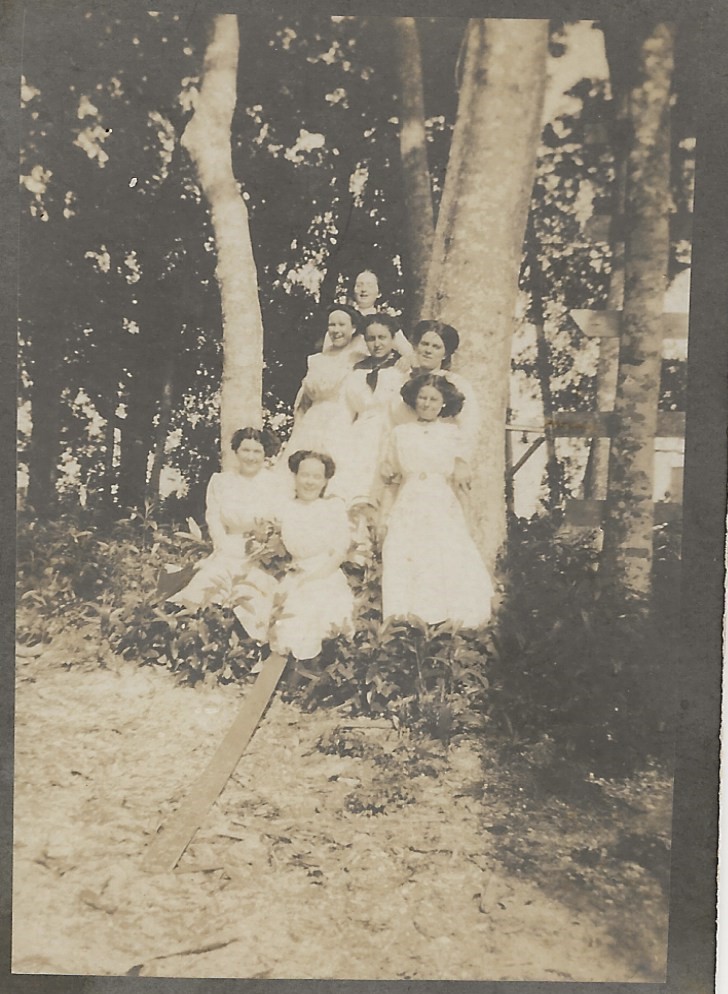
Grandma, second from top, far left. I think that is Fanny next to her in the scarf,
Grandma wearing her gold bracelet.
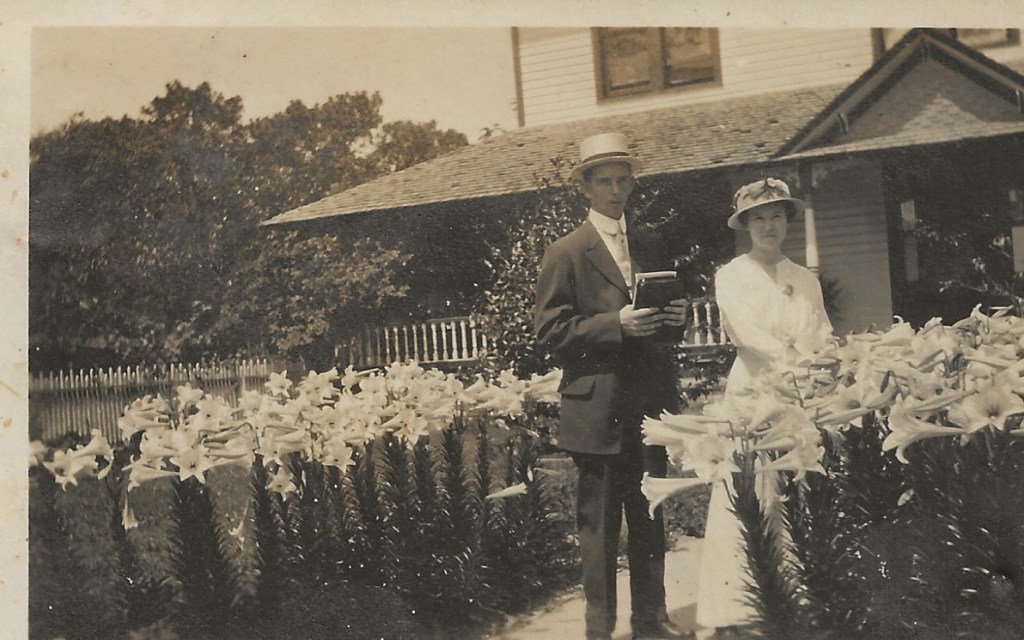
Grandma and Granddaddy in front of her parents’ home on Druid Road.

GRANDMA AND HER FATHER

Accidents will occur in the best-regulated families.  CHARLES DICKENS

      I want to tell the story of my maternal grandmother, Evie Wilson Boteler.  I don’t know how many installments it will take to share my memories of her; there are many, as she lived to be ninety-three.  At my age, I can’t relate the stories or memories in perfect order; I can only tell them as they come to mind.   She was the most important person in my life, because her home was very peaceful.  We had our share of turmoil, as families do.  But when I entered her house, any troubles I had were forgotten.  

     She was born Evie Caroline Wilson on February 12, 1892, in an area of Pinellas County called Bay View.  It later became part of Clearwater.  She was born on a lemon grove owned by a Mr. Sampson, in what they called a “hammock” between Bay View and Safety Harbor.  Her father worked for Mr. Sampson, and the family resided in a cabin on the property.  She was the first child born to James K. (“J.K.”) Wilson and his wife Velaria.  Velaria was not quite eighteen and had been married since she was sixteen, not at all unusual in those days.  I do wonder if Evie was actually born in the cabin; more likely she was born at the home of her grandparents, Dan and Sarah (“Sallie”) McMullen.    

        Grandma’s mother, whom we called Granny Wilson, was interviewed in her old age in 1950, and described life on the Sampson Grove as peaceful except for the year 1898, which was quite a year.  It was the year of the “big freeze.”  Anyone familiar with a sudden freeze to a citrus grove knows it can lead to immediate destruction of lives and incomes, especially well over a hundred years ago.  Though only a child, my grandmother remembered the ensuing panic, and how smudge pots were frantically employed to save the crop.  The grove was killed to the ground, but Mr. Sampson had lemon stock sent down from Orange Lake, which was grafted onto the trees.  It enabled the continuation of the grove and saved several families’ incomes.  (As I write this in January of 2022, I read that Florida is experiencing one of those freezes deadly to citrus groves, and the essential smudge pots are being hurriedly brought out.)  Making that year even more calamitous, the family’s home was destroyed by fire.  Granny also gave birth to twins, but one baby boy was stillborn. 

     This leads me to a story I heard about little Evie and the house fire.  She was six years old when it happened in that eventful year of 1898.  J.K. got his wife and children out of the cabin, taking a bad fall in the process.  He tripped over something left in front of the door and for the rest of his life was adamant about anyone leaving anything near a door.  Fire was an enormous threat in those days; sadly, a house fire was not uncommon.  I remember Grandma telling me about the fire as a warning to never leave anything in front of a door.  But my cousin Margaret told me an astonishing detail that was left out of the story.

      Grandma’s parents counted heads after they escaped, and came up with one missing – hers!  Little Evie had run back into the house to save her new Sunday dress.  Despite being only six, this reckless behavior seemed out of character for the grandmother I knew.  Even her childhood photo shows a serious-looking little girl, and she was in awe of her father.  It seemed incredible, but coming from Margaret, who “knew things”, I believe it was true.   I can see why Grandma neglected to tell me “the rest of the story.”

     Most of her childhood stories involved her father.  She and her siblings had great respect for him.  One story she told was quite bittersweet.   It was about when she went with him to Tampa to pay his taxes.  Clearwater was still part of Hillsborough County at that time.  Pinellas County did not secede from Hillsborough until 1912.  The causeway to Tampa had not yet been built, so the only route was around Tampa Bay through Oldsmar.  It was a trip of about thirty miles by horse and wagon, and Granddaddy Wilson would spend the night at a boarding house.

      He usually went alone, but Evie wanted so badly to go that he took her with him.  I am guessing that she was about ten years old, so this was around 1902.  I could tell as she told the story that she was proud to be allowed to accompany her father.  On their way back the next day, the lady at the boarding house sent a custard pie with them.  Evie was allowed to eat a slice as they rode.  Unfortunately, it had spoiled.  It made her very sick, and the little girl had to lie in the back of the hot wagon all the way home.  Her disappointment in the ruined trip, even in old age, was somehow very moving.

      When they thought no one was listening, I used to hear Grandma and her sisters tittering about the “Cousin Helen” episode.  It was a pretty wild story for back in the day.  Helen, their father’s niece, was very carefully brought up.  Her family lived in South Carolina.  As young teens, the girls and their parents made the long trip from Florida for a visit.  The town was more “citified” than Clearwater in the early 1900s.   The Clearwater girls felt slightly patronized by Helen, who seemed to regard them as “country cousins.”   No doubt meaning it kindly, she took them to the “moving pictures.”  She called it a special treat for them, saying that “she could go anytime she wanted.”  That particular phrase seemed to rankle the girls.  Growing up, I heard them say it many times, obviously as a private joke between them. 

     J.K. wanted the best for his children, especially an education.   Maybe Helen, refined and demure, was someone they should emulate.  But when Helen was a young woman, probably around 1920, things took a mysterious and scandalous turn:  She ran away from home.

      Helen eloped with a man she always referred to as “Mr. Smith.”  She was gone for years, with her whereabouts apparently unknown to the family.  My cynical mother used to wonder if Helen had ever  married “Mr. Smith.”  Was he perhaps already married?  Granddaddy Wilson didn’t mention her anymore, and I can imagine Grandma and her sisters being shocked and yet giggling about it. I say this because I was drawn into the saga of Helen the summer I was going on twelve years old.   

     In the 1920s, to escape the summer heat, Granddaddy Wilson bought an old country house in the mountains of Brevard, North Carolina.  It was built before the Civil War.  He died in 1933, but the sisters and their mother continued to spend the summers there.  It became a pleasant family tradition throughout the decades, Grandma and Aunt Lula becoming the last of their generation in the 1980s.   

     That fateful summer of 1960, my mother and I were in Brevard for a couple of weeks.  Suddenly, a big event unfolded.  My grandmother and her two remaining sisters, Aunt Lula and Aunt Emma, were going to visit Cousin Helen!  My mother was enlisted to drive.  We were invited for lunch, and we set off the next morning.  The town was over sixty miles away with I-85 not yet completed, and I remember it being a winding trip taking a couple of hours.  I sat in the front seat with Mom, and the three sisters sat in the back.  As people do when kids are around, they kind of forgot I was there.  Apparently this was their first time seeing Helen since she finally returned home after who knows how many years. 

      The ladies were by that time in their late sixties.  I was bored by the whole idea and didn’t want to go, but you did as you were told in those days.  Suddenly the conversation from the back seat started to get interesting, and my ears perked up.  That’s when I first heard about Helen’s “elopement.”  Soon my mother also had one ear tuned to the “gossip” in the back.

      I don’t know what the town is like today, but back then it was charming, full of lovely old homes.  We pulled up in front of a white frame house with a picket fence and a garden full of beautiful dahlias. But when Helen came to the door, I did a double-take.  She was tall, and a little scary.

     My grandmother and my great-aunts looked their age.  They got permanents at the beauty parlor for their naturally greying hair, and wore a little powder and Tangee lipstick.  Helen, unlike any elderly lady I knew, had bright blonde hair, along with red lipstick and a lot of rouge.  She had on big white “callow-tab” earrings, and a good bit of other jewelry.  The rest of her outfit consisted of casual “pedal pushers”.  Grandma and her sisters never wore pants back then.  They had on nice old-lady dresses, and of course their pearls.  But the wildest thing about Helen was that she was smoking!

       Her voice was loud but friendly, and she seemed glad to see her cousins.  The sisters’ good manners overcame their shock and hugs were given all around.  I didn’t dare look at my mother, knowing that I would break into nervous laughter.  So this was “demure” Cousin Helen. 

     The lunch was hospitable, but not up to my grandmother’s standards.  She would have fried a chicken and fixed potato salad, etc. for such a special occasion.  Helen only gave us tuna fish sandwiches, though she did serve them on fancy china.  She rather dominated the conversation, and spoke frequently of “Mr. Smith” and his business acumen, though other details about him were vague.  Apparently he was long gone by now.  Outwardly, the sisters appeared to accept their visit to this alternate universe as the most natural thing in the world. 

     Helen seemed to have lived an eventful life, and her voice level kept increasing.  My mother later wondered aloud if Helen had a drink before we came.  I very much doubt it, but Mom enjoyed shocking her mother a little bit.   Politeness forbade referring to her disappearance, but somehow I got the impression that Helen had been in California all this time.  Anyway, after two or three hours we left in kind of a daze, Helen waving goodbye with cigarette in hand.  The old ladies were quiet in the back.  They now seemed aware of my presence and spoke only in whispers. 

     Mom and I shared a bedroom in Brevard, and that night we stifled laughter about the whole awkward experience.  But faintly through the door I could hear giggles coming from downstairs too, from the country cousins. 

Grandma on front row, far left with Emma and Lula. Their brother Kelly is in the back with their parents. The youngest child, Elizabeth, was not born yet.

Aunt Emma, Aunt Lula, and Grandma. This was taken in Brevard in the 1960s.

MY AUNT PEGGY

Ye see her not, yet she doth shine in another country. SAMUEL RUTHERFORD [1629]                                                

      I want to write a tribute to my Aunt Peggy, who was a very important person in my formative years.  She died in the 1960s.  Although this story is bittersweet, my next one will reflect her sunny spirit.  She was not a person who could be condensed into one story. 

      My Aunt Peggy (or Peg, as she was also called) died when she was only fifty.  Even though I was already  in college at the time,  it seemed to mark the day I finally started to grow up.  I went from a rather feckless and silly girl to a young woman overnight.   Among other things, it was the first time I ever took a taxi.  That seems like a trivial thing, but it was the result of a decision I made to think of someone else, not just myself. It also taught me a cold lesson about time:  There’s never as much as you think. 

      I was visiting my friend Debbie in Fort Myers over Christmas break.  My mother had been in Miami taking care of my very ill Aunt Peg for months.  While I was in Fort Myers, my mother called to say that she had passed away, and told me to take the bus to Clearwater to be with my grandmother.  Debbie’s mother was so kind and thoughtful to me when I left.  She could see that I was stunned; I felt so alone.  I looked out of the bus window for hours.  It wasn’t a coastal route; it looked like the plains of Florida to me.  We seemed to stop at every little town, sparsely populated then. Everything seemed ugly.   

     When I was a child, Aunt Peg would run interference for me when I would make my mother angry.  When I was about twelve (again, being feckless), I lost my record player somehow and was scared to death to tell my mother.  In those days, portable record players were almost the size of carry-on luggage, so I don’t know how I managed to do this.  For some reason, Aunt Peg was at our house, and I confided in her.  Like magic, I didn’t get in trouble.  She was about eleven years older than my mother, and Mom respected her.  She also gave me tips on how to stop biting my nails, little things like that; we had “girl talk.”  She was affectionate and laughed a lot.  I missed her when she would leave, knowing that I wouldn’t see her again for months.  She and Uncle Richard were teachers in Miami and they only came to Clearwater for a few weeks in the summer, and again for the Christmas holidays. 

     She taught second grade, and Uncle Richard taught high school woodworking.  He was talented, and I have a few pieces of furniture that he made, including a lowboy made of Cuban mahogany.  He cut the wood on Key Largo and brought it back in his sailboat. 

     I do wonder why they chose to teach in Miami rather than locally.  Was the pay better?  Probably, but I also think it was because Uncle Richard was a serious sailor, and made regular trips to Bimini.  I think that back in the day he would also sail to Cuba, obviously before its tragic fall to the communists.   He was very close friends with Clark Mills, a Clearwater boat builder and sailor that everyone remembers.  I have a memory of a wonderful day sailing with them and Aunt Peg on the bay in Clearwater.  During their courtship in the 1940s, sailing together constituted a date.  Her diary mentions going sailing with him at least once a week, and he proposed to her on his boat. 

     I was struck whenever I visited Miami by how much Aunt Peggy’s neighbors loved her. She was very social, a “joiner”, who enjoyed people and put them at ease.  She and Uncle Richard had no children, so it seems that her Miami friends were her “family.”  Her neighbors were distraught when she died, and I remember our family being amazed that several traveled to Clearwater for her funeral. 

     Getting back to my bus ride:  I arrived in Clearwater about 9:00 that night.  I was supposed to call my grandmother so she could pick me up at the bus station in downtown Clearwater.  It was New Year’s Eve and everything seemed deserted.  The Christmas lights were shining all over town, and I remember it being quiet. The New Year was beginning, but I knew that something had ended, and I would never be the same.  I loved Aunt Peggy with all my heart.  She was the delight of everyone in our family, the encourager. I thought she would get better; I see now that my mother wanted to keep the worst from me.  She and Aunt Peg wanted me to have a fun New Year’s Eve with my friend.

      The “adult” idea came into my mind when I saw a taxi parked outside the bus station.  I took it to Grandma’s house, so as not to burden her more.  I didn’t call; I just arrived.  I knew that she would not want me to be “extravagant”, although the ride was just a few blocks north.  Sure enough, she was as surprised as if I had arrived in a chauffeured limousine.  But she looked so tired that I knew I had made the right decision. 

     My grandfather had died in 1961.  Grandma still had her “winter guests”, so she was not technically alone in the house.  But she was alone downstairs, and her roomers wouldn’t want to intrude too much.  My other aunt lived in Clearwater, but she and my uncle couldn’t leave my disabled cousins overnight.  I guess that’s why my mother wanted me to be there instead of returning to Miami, so that someone could be in the house at all times.  Mom would be helping make long-distance arrangements for the funeral in Clearwater, and then she and my father would drive in from Miami, with Uncle Richard following in his own car.  It occurs to me how different things are today.  Taking an airplane was still a luxury in my family, unless for some reason you had to go a great distance.  In the days before interstate highways, the older folks would usually take the train.  Also, they didn’t seem to hurry funerals as much as they do today.  It took people a while to get to places back then.

     I never saw my grandmother cry in front of me, although she had much sorrow in her life.  Maybe it was a combination of keeping emotions rather private and not wanting to be a burden to others.  But that night she talked a lot about Aunt Peg, telling stories the way people who are grieving do.  One has stayed with me:   Peggy was at FSU (still a women’s college back in the 1930s), and called home asking for dues money to join a sorority.  This went over like a lead balloon with Grandma.   It was still the Depression, and on top of that my grandfather was laid up with a broken leg.  When her mother said no, Peggy ended up getting the money from her grandmother.  (It was a loan which she paid back.)  Nonetheless, Grandma’s exact words to me that night were, “I was so provoked!”  I was astonished, because I had never heard her criticize Peggy before.  It was oddly comforting to see that Aunt Peg was not only imperfect, she even had a feckless side.  That made her a little like me, so maybe that meant I was a little like her.          

   I have her diaries she kept before she was married, and they are charming to read.  I want to write a little more next time about her life as a child and as a single young woman during WWII. 

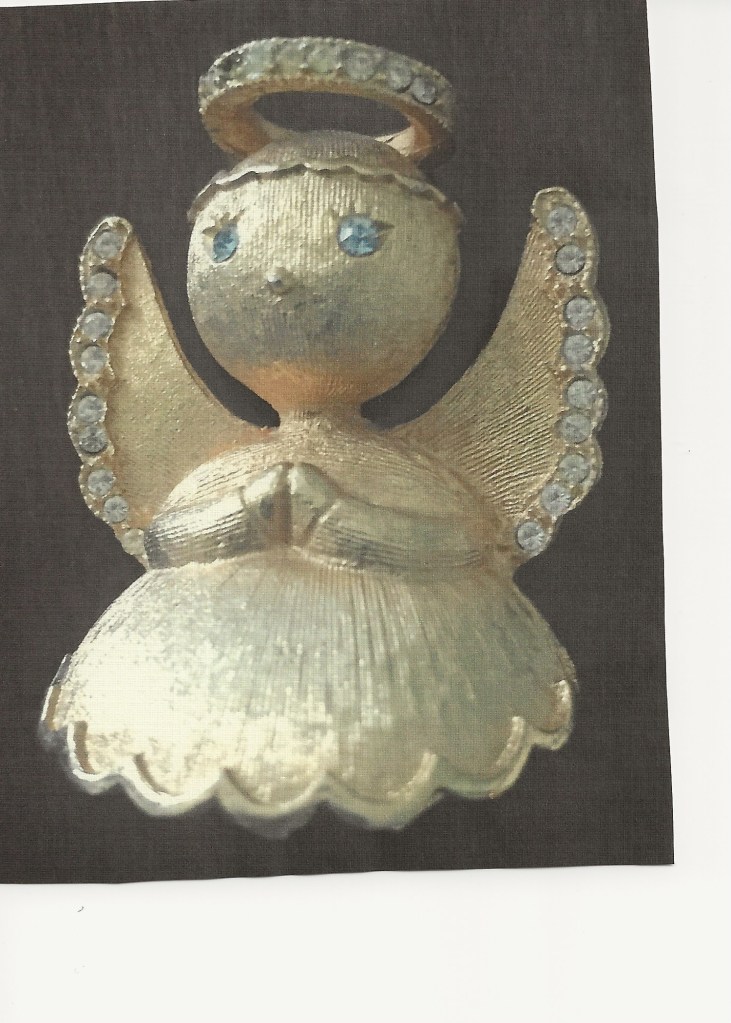
     EPILOGUE:  A friend had given Aunt Peggy a little angel pin from Burdines.  Aunt Peg asked her to purchase another one so that she could give me a special little gift.  She gave it to me from her hospital bed.  I was touched, and thanked her sincerely.  Mom told me to be sure and write Aunt Peg a thank-you note immediately, before I left for Fort Myers.  My mother was always a stickler about prompt thank-you-notes, so I did what I usually did, and procrastinated.  I thought there would always be time for things like that, and I left Miami meaning to write the note later.  Naturally, “later” never came.  For many years, I couldn’t wear the pin because I felt sadness and shame when I would look at it.  Now it gives me pleasure to wear it at Christmas; I think of Aunt Peg as my personal angel.  I’m over seventy now and still kind of silly.   And I still miss you, Aunt Peggy.

Aunt Peg in the 1940s. I think she is at my great-grandmother’s house, with Druid Road behind her.
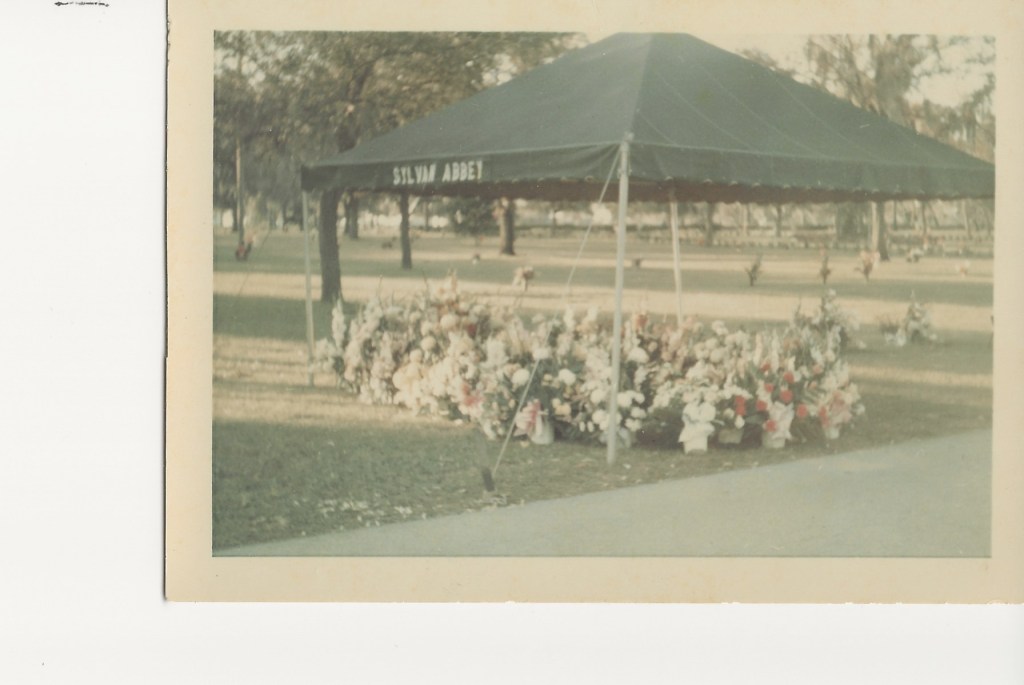
There was an overwhelming amount of flowers. These were all that would fit under the canopy.

GRANNY

     The foregoing generations beheld God and

nature face to face; we, through their eyes.

                                                                                                                                              RALPH WALDO EMERSON [Nature] 1836

                My great-grandmother knew me, yet she didn’t know me.  She could sometimes speak my name and talk to me, but her voice was very soft and a little bit garbled.  She was always in a chair and couldn’t walk by herself.  My mother said she had “hardening of the arteries.”   I never knew my great-grandfather, since he had been gone since 1933.  Granny died in 1958 at the age of eighty-four.   I was only ten years old, so my memories of her are dim.  But my impressions are of a gentle old lady much loved by her family.  It was then and it is now hard to imagine her in the 1800’s as a young girl growing up in sparsely populated Florida, riding to school on horseback.  Her children and grandchildren said that she loved to laugh.   

                I always felt that her story was typical of most Americans at that time, balancing a need for survival and love of family.  She was born Velaria Elizabeth McMullen in 1874, the oldest of twelve surviving children, born in her grandfather’s log cabin.  He was James McMullen, though he went by Captain Jim.   They lived in an area then known as Bay View, near the Tampa Bay side of what became Clearwater.  Later her father Dan homesteaded nearby and built a house close to the McMullen Cemetery.  There are many good genealogists in my family that can relate detailed stories about those times.   I can only add my fading memories of what I have been told.

 Granny was interviewed for the Clearwater Sun in 1950, and gave many interesting details about life back in the nineteenth and early twentieth centuries.   It was a look at a bygone world involving unbelievably hard work, and devotion to family was paramount.  They were from a clan originating in Scotland who eventually found their way to Florida in 1850.   They were hard-working farmers, pioneering the state, and their main crop was citrus.  Granny remembered though, that hospitality was an essential part of life.  She loved it when there was some sort of celebration and everyone gathered at her grandfather’s cabin.  In the days when everybody had umpteen children, these gatherings must have been something to behold.  Music and food spread out from the house to under the trees.  They played games and danced.   The music was comprised of fiddles and even an organ.

                 Her life as the oldest daughter of twelve children did NOT involve opting out of chores. Very hard work was involved just to survive in those days, and everybody had to help.  She had to be her mother’s right hand and learn how to cook (including for the hired man), run a house with all that that entailed, tend to animals, and help out on her father’s grove when necessary.  She said that her schooling was interrupted a lot because she had to help her mother so much.   It all sounds harsh today, but the old ones in my family spoke mainly of square dances, music, and lots of laughter when the work was done.  They talked about giving love and care to the little ones, of whom there were many.  I was told by my cousin Jean that the big family loved children; they were enjoyed, and the little ones indulged.

                In 1890, when she was sixteen, she married James Kelly Wilson.  They met at church.  He was older that she was and a bit established.  You had to be in those days before you took on the responsibility of a family.  Velaria was married at the foot of her mother’s bed because her mother was still recovering from childbirth.  She said that this was her only regret – leaving her mother with a new baby.  She must have had her parents’ blessing, but the mindset of an oldest daughter was hard to shake off.  One story I love shows the wisdom of her new husband.  He didn’t like to dance, but being sixteen, she did. What he would do was take her to square dances and let her dance to her heart’s content while he sat on the side.  She was young and I love how he understood her need for a little fun. 

                 Granddaddy Wilson came from South Carolina, and worked for the owner of a lemon grove, Mr. Sampson.   His dream was to own his own grove.  He and Granny worked extremely hard to make this happen, while raising five children.  The oldest was my grandmother, born in 1892, and she remembered how hard her parents worked.  The children had to help the best they could.  What they could do was size fruit.  I guess the oranges passed down some sort of chute, and the children’s job was separating the smaller oranges from the more desired large ones.  My grandmother also told how she went to Sylvan Abbey School on horseback just as her mother had done.  I loved to picture this, because I had never seen my grandmother on a horse in my life.  I guess children just assume that their elderly relatives were born old. 

                Nobody gets through life without enduring grief, and Granny had her share.  In 1898, after having three girls, she had a boy, James Kelly Wilson III, whom they called Kelly. He was born a twin, but his brother died at birth.  He was a much longed-for son, and loved by his sisters.  A few years later another daughter was born, and that completed their family.

                In 1921, when he was twenty-two, Kelly was riding with two other boys in a cut-down  unpainted Ford.   I have been told that it was one of the first cars in Clearwater.   They were driving along the beach and attempted to climb the car back up on the road.  It wasn’t even a hill, but of course the sand was very soft. The right front wheel crumbled, causing the car to turn over.  One boy was thrown clear, but Uncle Kelly and the driver were pinned under the car.  The driver escaped serious injury, but Uncle Kelly was killed.  It was ruled an accident with no one to blame, the car going about fifteen miles an hour.  I wonder since cars were so new if the boys just didn’t understand about soft sand. 

                My friends who have undergone the tragedy of losing a child are the only ones who can understand how Granny and Granddaddy felt.  Naturally, things were never quite the same.  Granddaddy rallied a little better than Granny, but she grieved a very long time.  It was talked about so often in our family.   My grandmother would talk about the death of her brother when I was a child in the 1950s.  I didn’t even realize that it had been over thirty years.  It affected all of them.  Even my mother talked about Uncle Kelly, who died before she was born.   But somehow life went on.  

                  Before this time, the family had moved closer into town and had a grove near South Ward School, to provide the children a better opportunity for education.  Clearwater was still pretty rural.    After the girls were mostly grown and married, Granny and Granddaddy felt that the city was growing too fast.   They moved to a house on Druid Road.  It had a little acreage and was still in the country.  This is the house that I remember.  It wasn’t what you would call rural in the 1950s, however.  What would they think today!

                Despite the sadness that every family endures, my memories of our gatherings at Granny’s are of laughter, stories, and plenty of food.  We kids played outside and would get stains from the big mulberry tree growing there.  The barn now housed a car.  Being an only child, to me all the family under one roof seemed enormous.  But being one of twelve, I bet Granny didn’t think so. 

                This is dedicated to Dora Ward, a dear friend of Old Clearwater and a wonderful storyteller.  She was much appreciated and is greatly missed.  

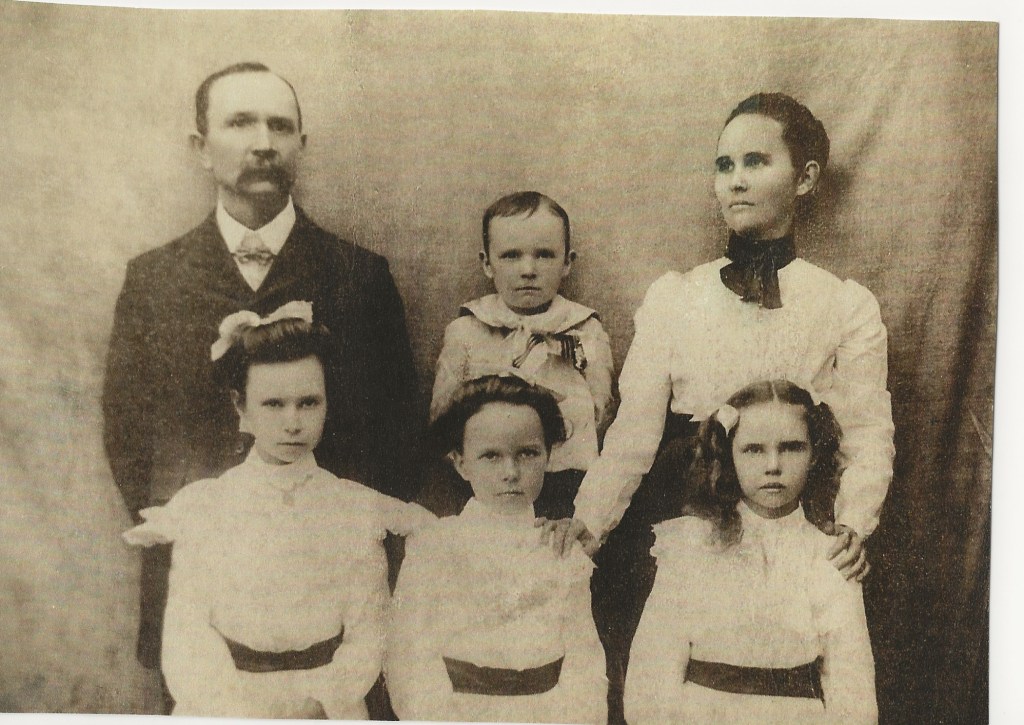
I think this is Granny’s wedding picture, probably 1890.

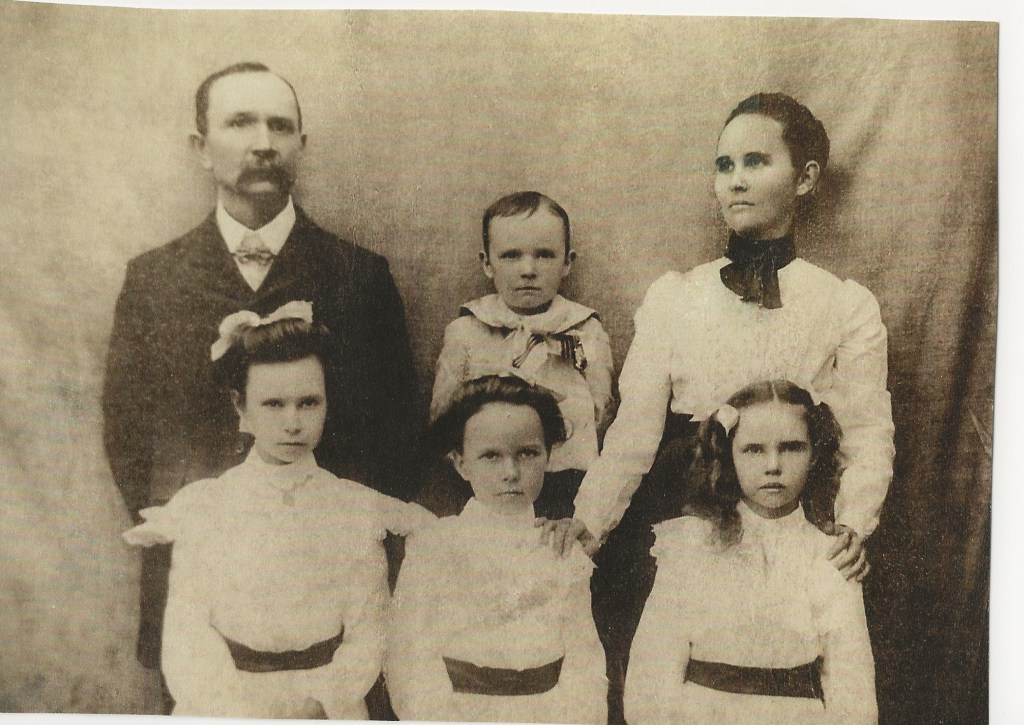
The Wilson family about 1902, before their youngest daughter was born.

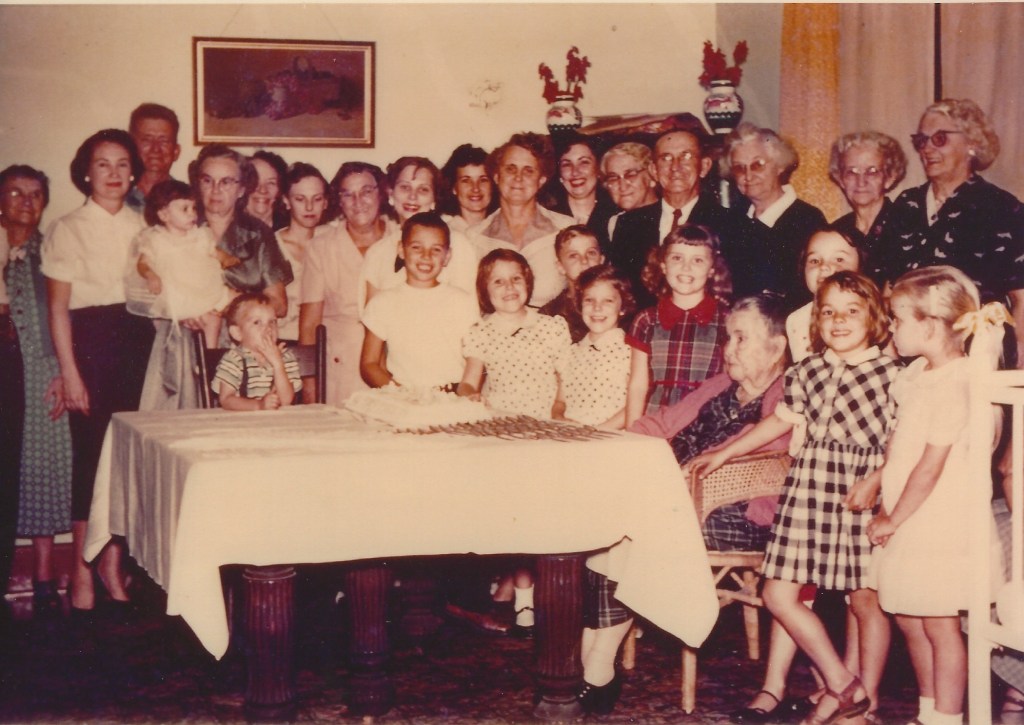
This was taken in 1958, a month before Granny died. This is just part of the family.

GRANDDADDY

                                                        By the work one knows the workman.

                               JEAN DE LA FONTAINE   [1668]

     I never heard exactly why my grandfather came to Florida, but I think it had to do with the land boom.   Henry Plant had extended his East Coast railroad over to the West Coast, so Clearwater was experiencing a building boom in the 1900s.  It would accelerate after World War I ended in 1918, and explode after WWII.  As a young carpenter in Maryland, I wonder if he heard through the grapevine that Pinellas County was going to be the place for steady work.   I’m guessing that he arrived in 1913 or 1914 because he married my grandmother, a local girl, in 1915.  That story itself is kind of amusing to me.

     All my life I never saw my grandfather attend church.  Grandma went faithfully every Sunday to First United Methodist.  I think she was even a founding member of her Sunday School class, the Friendly Helpers.  It never seemed to be a point of contention between them, or maybe by the time I came along it had ceased to be one.  He didn’t seem to be against religion; I think he was raised in a churchgoing family.  I just assumed it was because he was shy; but for whatever reason he just wouldn’t go, except for a wedding or something.  So I laughed out loud when my mother told me that he had met my grandmother in church!  I guess it was the only place a young man could meet a nice girl in those days, when you were new to town and didn’t know families who could introduce you.

     It was an open secret that Granddaddy hoped for a son in his family of three daughters.  Today’s girls might disapprove of that, but it wasn’t unusual back in the day.  My grandmother felt the same way; I even found a letter from a friend of Grandma’s back in 1929, congratulating her on expecting again (late in life).  She hoped that third time would be the charm and maybe it would be a boy. Surprise!  It was my mother, born with red hair.  Though disappointed, Granddaddy had not lost his quiet sense of humor.  He had a redheaded friend named Doc.   He said, “Doc, have you been visiting my house?”  Mom loved to tell that story.  

     After that, he accepted his “fate” and seemed to enjoy his daughters.  However, he did not give in completely.   My mother was very proud when he gave her a child-sized football.  She was the only one in the neighborhood with one (it being the Depression), so the boys could only have a game if she brought the ball.  Naturally, they had to let her play too.  Granddaddy would also take my mother to minor league baseball games at the old Clearwater Athletic Field.  However, he took things too far when he took Mom with him to the boxing matches in Tampa.  Grandma didn’t like that.

     The strangest story I heard growing up was the one about my mother’s playhouse.  He had built her a very nice one, divided into two rooms.  After she outgrew her playhouse, a little old lady moved into it!  Granddaddy added another room, she had it moved somewhere, and it became her home.   As a child it sounded crazy to me, but the family assured me it was true.  They would just say, “It was the Depression.”

       A story that Mom did not share so eagerly, and I just happened to find out, was the time she got caught coming home late as a teenager.  She and Granddaddy were on their own for a few days while Grandma was out of town.  Her sisters were gone and married; they were much older than she was.  I think Mom was about sixteen when this happened, around 1945.  I don’t know what her curfew was, but anyway, she missed it.  The house was dark.  She entered the back screened porch, trying to quietly open the door, which was never locked.  Surprise, it was locked this time.  No luck with the front porch either.  Returning to the back, she saw that the window into the kitchen was open.  It was high up and very small.   She contorted herself up and over, landing in the kitchen sink.   She said it was painful.  But no sound from Granddaddy, and she sneaked off to bed. In the morning, he asked her if she had a good time the night before.  That was all he ever said.      Mom would kind of laugh when she told that story, but in a nervous way.  She knew that he had enjoyed his little joke, but she would not dare to let it happen again.

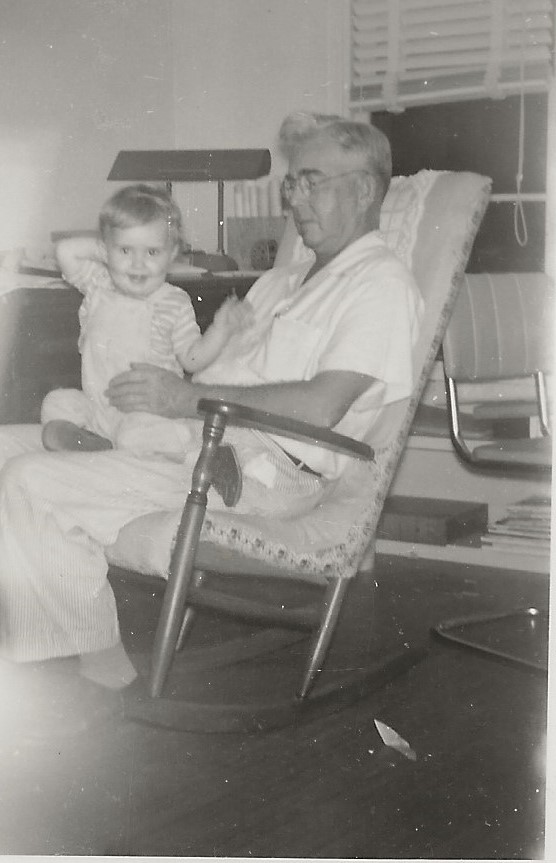
     At the end of every day Granddaddy was always sitting in his rocking chair.   Now I sit in it every day.   There is an indentation shaped like a fingertip at the end of the wooden armrest.  My own finger fits perfectly in the groove. There was kind of a mystery about this rocker.   When Granddaddy arrived on the train from Baltimore, he brought the rocking chair with him.  I couldn’t think why he would lug it all the way from Maryland to Florida, surely paying extra. The only place he could stay would be a boarding house, and of course his room would be furnished.  Even my mother was puzzled as to why he did this.  I spoke with my first cousin Margaret several years ago about this; she was the daughter of my mother’s oldest sister and knew things Mom did not.  She was sure of the answer:  the chair had belonged to his mother.  I checked my great-grandmother’s death date, and it was 1910.  Since he left Baltimore not many years after, it makes sense now.  I never thought of my elderly grandfather as once being a young man who missed his mother.   Now I wonder if the indentation might be from his mother’s hand.  Now that would make a beautiful ending to this story.

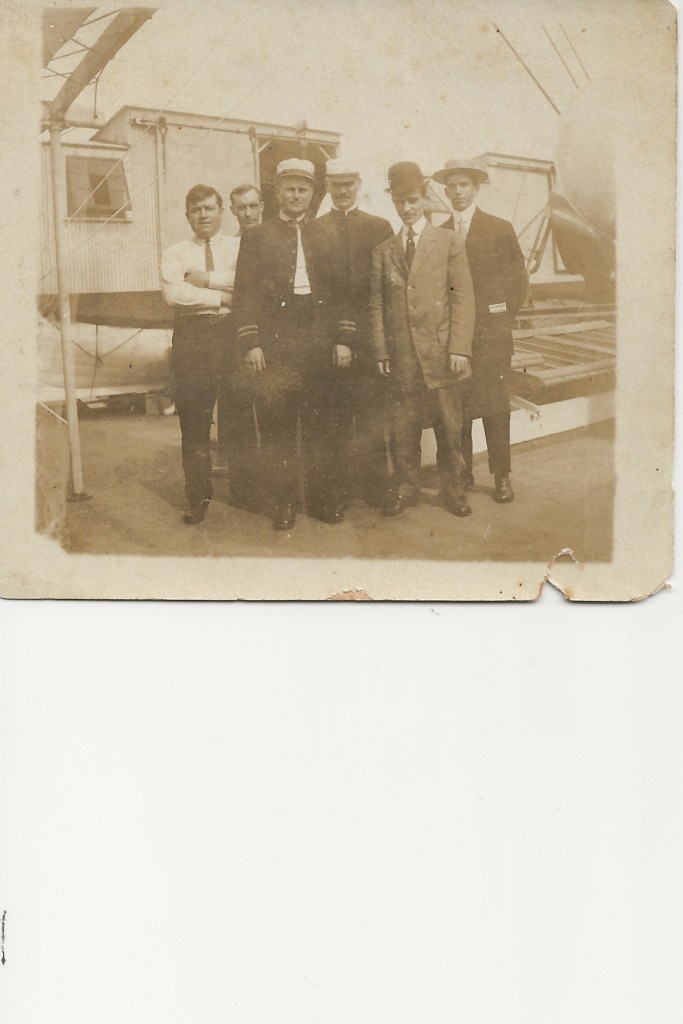
*Granddaddy on far right in group photo.   Him in his rocker with one of his adorable grandchildren.

SHADY SIDEWALKS

           I think that I shall never see a poem lovely as a tree

                                                                                                JOYCE KILMER [Trees] 1913 

     I have been gone from my Florida childhood home for decades.  I’ve made regular visits but as everyone knows, it’s not the same after a while; so many things change.  I’m one of those people who have put down deep and beautiful roots somewhere else, but feel that where they grew up is their true home. 

     On our way to visit Clearwater the past few years, we would sometimes wind through small old Florida towns instead of sticking to the interstate.  The first time we did this, a feeling of déjà vu came over me.   I felt emotional, and finally figured out that seeing the tree-covered sidewalks was the reason. 

     In the 1950’s, sidewalks provided my first taste of freedom.  That was something I hadn’t forgotten.  It was exhilarating to be on my own.  Starting when I was about nine, I could walk, skip, or ride my bike as far as my strength would take me, and it was the same for other kids.  We did have to provide the general parameters of where we were going, and be back for meals.  If there was a house where a person who was kind of strange lived, we were told to avoid it if possible or just pedal by as quick as we could.  If we stopped at a friend’s house and were invited to play inside, we had to telephone home and ask permission.  For those of us without watches, we somehow knew when it was time to go home.

      My earlier memories weren’t as clear until I noticed the sidewalks covered by live oaks in the old towns.  Suddenly I remembered playing under those trees when I was very young.   I played every day in the black sand behind my grandparents’ house with a child’s tea set that had belonged to my aunts.   My mother and I were living there temporarily because my parents had split up, my mother and I returning from Alabama.  We came on the train. 

     Divorce was kind of rare in those days, but I wasn’t very sad about it.  My young parents’ marriage was volatile and I was glad to return to this peaceful, tree-covered place.   Left to my own devices, I played until it got hot and it was lunchtime.  I would have a “necklace” around my neck – beads of perspiration mixed with mud.  Then I would get sort of hosed down outside and come in for lunch, or dinner, as Grandma called it.  Granddaddy had come back from his garden and was already seated at the kitchen table.  We had a hot meal unless it was ham or chicken salad, always with vegetables from Granddaddy’s garden. Grandma had a pot of water boiling so the corn could be cooked fresh from the ground.   I had to try all vegetables, but corn and black-eyed peas were my favorites.  After lunch I had to lie down or play quietly inside until the hottest part of the day was over.  

       A while later, in 1955, I was enrolled in the second grade.   My mother would drop me off before she went to work, but after school I walked the several blocks back to my grandparents’ house.  My route was Osceola Avenue, on a sidewalk covered by live oaks and old palm trees.  The people I encountered were always elderly.  They would say some friendly words as they walked by.   

     As you have guessed, the feeling that the shady sidewalks evoked wasn’t as much about the trees, but about my first awareness of beauty and security.   Those memories are where my true home is. 

Winter Guests

WINTER GUESTS

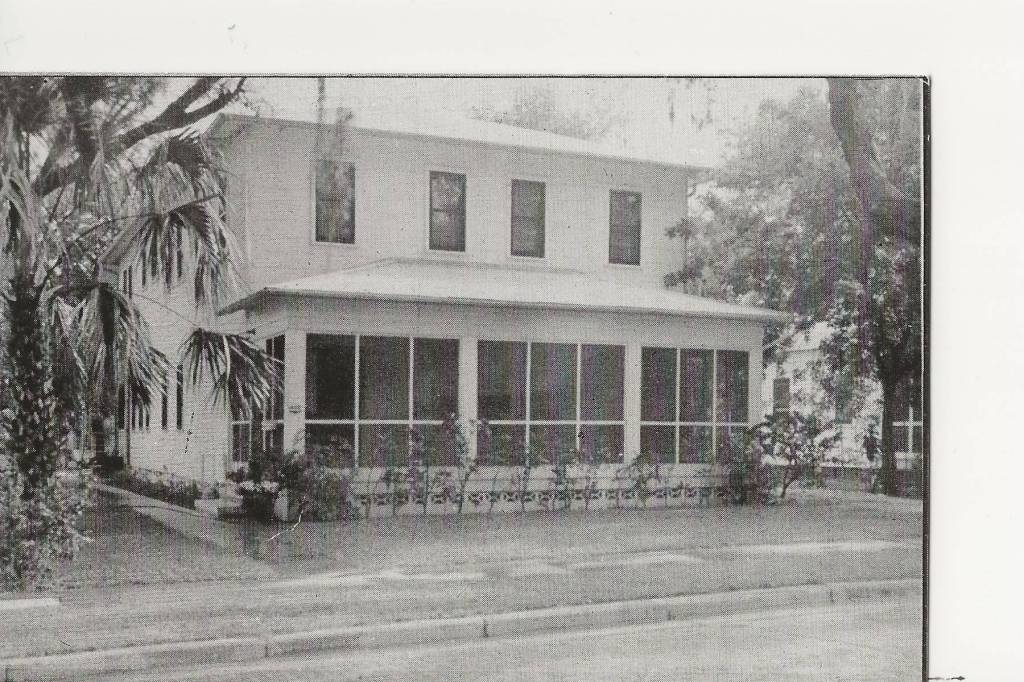
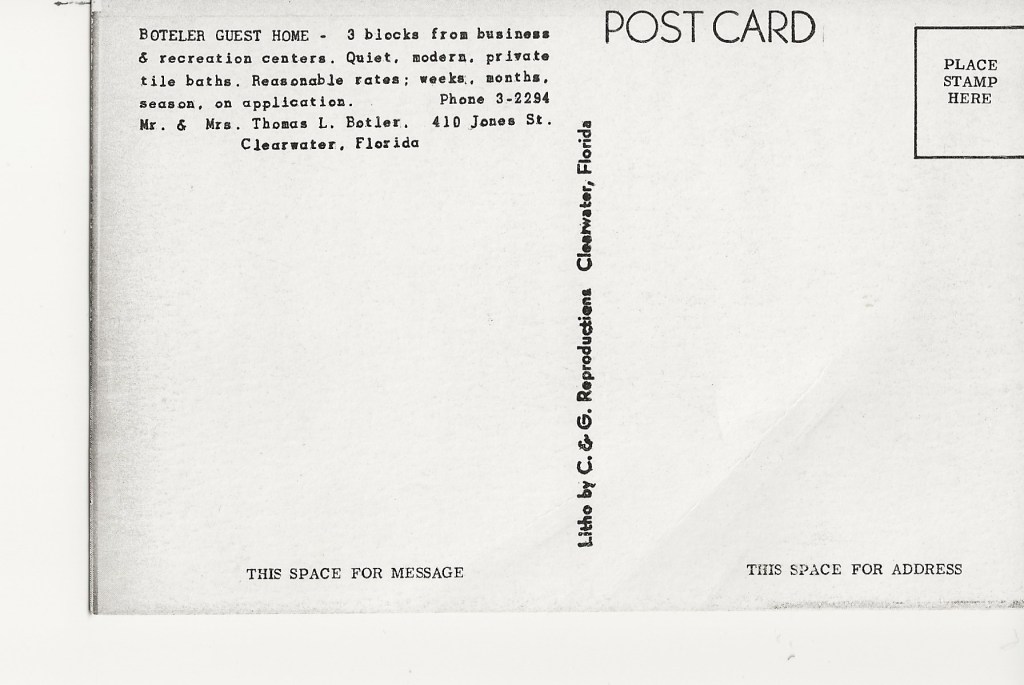
After World War II, when they were retirement age, my grandparents started a business venture. Native Floridians, they opened their home to “winter guests.” Their children were grown and I think it evolved naturally from my grandmother’s inborn hospitality and my grandfather’s experience as a contractor. He remodeled the upstairs into four apartments along with two more over the garage, and it wasn’t long before they attracted “snowbirds” from up north. One in particular held my fascination – an old-maidish lady whom I was encouraged to call Miss Elsie. She and a small number of “regulars” stayed there every winter for forty years.

I first remember her about 1955, when I was seven years old. She fascinated me. I had never seen anyone like her before. I knew she was a grownup, but she looked like an old little girl. She had baby blue eyes and curly gray hair in ringlets, such as might peek out from under a bonnet. She would stand at the open door of the living room and sort of coo for my grandmother. She usually had to call several times, because Grandma was hard of hearing and the kitchen was at the other end of the house. Many times I would just go and fetch her, as I was irritated at my dignified little grandmother being “called.” I see now that Miss Elsie was just observing proper etiquette. Although Grandma was actually relaxed about these things, to Miss Elsie it would have been a breach of good manners to cross the threshold without being invited in.

My grandparents’ place was not a boarding house. My grandmother didn’t serve meals. She did enjoy cooking, but I think Granddaddy would have seen it as an intrusion and besides, my mother and my aunts didn’t want Grandma working even harder and “slinging hash”, as they called it. Fortunately for the guests, the Grey Gull Inn was half a block away, right on the bay. It was a small hotel, very genteel. Miss Elsie usually ate dinner there or had it delivered in a big wicker basket, with china and silver nestled in snowy white napkins. I was fascinated by the extravagance; we never had meals delivered to our door. Unfortunately for Miss Elsie, she could no longer avail herself of this luxury in later years. By the 1970s the Grey Gull Inn went with the times and dinner came on paper plates, with disposable napkins and plastic utensils. I remember the day I heard her telling her my grandmother this, horrified. Grandma was practical and had grudgingly adapted to wasteful “throw-aways”, but tactfully kept her opinion to herself.

When I was about ten, something exciting about Miss Elsie happened. I heard my Aunt Peg giggling about it with my mother. Apparently they had just found out that many years ago Miss Elsie had been married! She had been a bride for about a month, Aunt Peg whispered to Mom, “but she didn’t like it.” In my mind it added an element of mystery and savoir faire to proper little Miss Elsie. Anyway, it seemed her husband wasn’t one to hold a grudge. He was gentlemanly about it and continued to supplement the small inheritance that she lived on. I got the impression that he was quite a bit older, so how long this went on I’m not sure. At any rate, I believe she lived to her late eighties and only death stopped her winter visits.

Grandma continued to keep her house open in the winter until a year before her death at age ninety-three. I believe that she knew one secret of a good life – work hard at something you enjoy. And make friends along the way.